Working Memory Guide
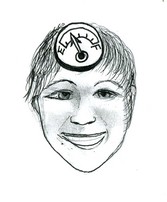
Working Memory Guide: Good working memory is vital for academic learning.
When reading, working memory aids our ability to not only remember the meaning of the words on the page but also how they link to the words, sentences and paragraphs on the previous passages.
What is working memory?
Working memory is the ability of individuals to mentally grasp and shape new information within a short time-frame.
Susan Gathercole refers to working memory as being like a post it note on which we rapidly jot down important information before we lose it.
Working memory is active. That is, working memory aids our ability to hold onto information
long enough so that we can use it to help us solve a problem or complete a task.
It is also very limited. The volume of information we can hold onto and manipulate in working memory is quite small due to it being a limited capacity system.(Gathercole, 2007)
Working Memory Guide cont...
Many routine tasks that we undertake in our daily lives depend on working memory.
For example,
suppose you are at the supermarket and have a list of ingredients for a dinner party. You have set a strict budget for how
much you wish to spend. For instance, $30 is your budget to make a lasagne. You've used this
particular recipe before so you don't need to write a list of ingredients, as they are stored in
your memory.
So, you select and place the ingredients into your shopping trolley and add the price of each
individual item in your head, mindful that you don't wish to exceed your nominated budget of $30.
In this example, working memory operates in a dynamic way to allow you to calculate the items on the run and store the information. It's a form of mental juggling. You wish to remember
the price for each item just long enough to add it to the total price.
It is the tallying of the prices - the mental arithmetic - that is the difficult task here. When any newly acquired information is manipulated or worked in some way, then that is a sure sign that working memory is operating.
But what happens when you get distracted?
Just suppose, while busily, and with intense focus, you tally the prices of the ingredients together
in your head, you bump into an old friend and have a brief chat.
This will most likely result in you forgetting the price
for each ingredient and the total amount. The result - a complete loss of the stored information.
The metaphorical post it note vanishes in a puff of air. In this situation you would simply have to begin your calculations again.
Click on the link to learn more about
Learning and Working Memory.
References:
Gathercole, S.E. & Alloway, T.P. (2008) Working Memory and Learning: A Practical Guide for Teachers Sage Publications Ltd
Content Updated 8/11
Return from Working Memory Guide to Home Page
Enjoy this page? Please pay it forward. Here's how...
Would you prefer to share this page with others by linking to it?
- Click on the HTML link code below.
- Copy and paste it, adding a note of your own, into your blog, a Web page, forums, a blog comment,
your Facebook account, or anywhere that someone would find this page valuable.
|


