Reading Brain Review: Maryanne Wolf's, Proust and the Squid.
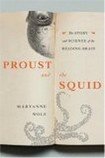
Reading Brain Review: 'We were never born to read;' so begins Maryanne Wolf's journey into
the science and story of the reading brain.
Maryanne Wolf is the Director of the Center for Reading
and Language Research at Tufts University. She is one of the leading dyslexia researchers in the world, so the insights she offers in Proust and the Squid are, at times, revelatory.
For instance, did you know that Albert Einstein, Leonardo DaVinci and Thomas Edison were all dyslexic?
They were each able to overcome their reading disability to become some of the greatest artists, thinkers
and inventors of all time. Another piece of information I found fascinating is that the brain has no localized 'reading center,' but instead borrows and uses multiple mechanisms, brain structures and neurons during the reading process.
The Squid and the Whale begins with a description of the history of reading and written language. Wolf explains
that the Sumerian cuneiform (wedge like appearance)was the first true writing system, developed in ancient
Mesopotamia roughly 3000 years BCE.
Wolf then guides the reader through the complexities of the 'natural history' of reading development.
She spends a good deal of time explaining orthographic patterns and their acquisition, reading's effect
on word and world knowledge, and the problems with vowels. A humorous and quite brilliant anonymous poem about just how confusing English vowels are to novice readers can be found here.
Reading Brain Review cont...
The last several chapters of Proust and the Squid are devoted to dyslexia and how the dyslexic brain is wired
differently from typical brains.
The last few chapters are a fascinating read, but due to the complexity of the writing can be quite a challenge to get through. It's certainly not light reading, but Wolf provides many clear and interesting diagrams of the
brain to illustrate her points, which eases some of the mental burden for the reader.
Proust and the Squid is a highly informative and important book about the science of the reading brain. I highly recommend it to speech-language pathologists, teachers and educational psychologists.
To all those language and literacy nerds out there, who enjoy reading well written books
about the science of reading and language, will find this book a challenging but exhilarating read. But like me, you may need to read it slowly.
Return from Reading Brain Review to Speech Pathology Books
Enjoy this page? Please pay it forward. Here's how...
Would you prefer to share this page with others by linking to it?
- Click on the HTML link code below.
- Copy and paste it, adding a note of your own, into your blog, a Web page, forums, a blog comment,
your Facebook account, or anywhere that someone would find this page valuable.
|


