[?]Subscribe To This Site


|
Mercer Mayer Review: A Boy, a Dog, and a Frog
Mercer Mayer Review
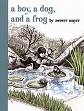 The Mercer Mayer series of books are highly useful language teaching tools.
The Boy, a Dog, and a Frog is a wordless picture book, and like the rest of the series the narrative is driven by simple and delicately drawn black and white illustrations. The book has no text, which is the story's chief advantage. The pictures require active engagement by the reader. Each illustration features the boy performing a number of actions, both voluntary and sometimes involuntarily, in his efforts to catch a pond-dwelling frog. The boy's and frog's actions are always clear. This is because Mercer Mayer makes excellent use of facial expression to communicate emotion. Mayer also uses the environment to great advantage. The setting is ingeniously established from several different points of view. Consequently, as readers, we always have a sense of scale and the relative positions of the characters. For instance, in one illustration the boy stands in the water, hands on hips, and glares at the frog. We observe this positioned so we are looking directly over the agitated boy's shoulder. The frog sits amiably on a log that juts from the water and looks back at the boy. On the next page the author presents a real treat, if you look for it. He shows the exact same scene, but this time we observe the boy's position looking over the frog's shoulder, as he looks back at the boy. In those two juxtaposed illustrations, the author establishes the mood of the two protagonists, where they are in relation to their surroundings, and also to each other. It's a simple but effective technique that would be difficult to describe with text alone. It's a solid endorsement of the truism that a picture tells a thousand words. Mercer Mayer Review cont...
The Boy, a Dog, and a Frog features many such clever illustrations. There is no limit to the amount of questions, both literal and inferred, that can be generated from the actions of the characters and the sequence of the story. I have derived many language learning goals from the A Boy and a Frog books. I use them daily with very young children with language impairment. |
