Why Strong Vocabulary Shapes
Learning Success
Why Strong Vocabulary Shapes Learning Success
One of the strongest predictors of a child’s success at school is vocabulary knowledge.
The words a child understands and uses shape almost every aspect of learning. Vocabulary supports reading comprehension, classroom discussion, writing, memory, reasoning, and affect social interactions. The more words a child knows, and the more deeply those words are understood, the easier it becomes to connect new learnings to an existing knowledge base.
But having a strung vocabulary is far more than simply memorising word lists.
Speech-language pathologists often use the term semantic knowledge when talking about vocabulary development. Semantics refers to meaning - how words are understood, connected and used across different situations.
In simple terms, semantic word knowledge is a child’s understanding of words and the relationships that exist between them.
Why Strong Vocabulary Shapes Learning Success - The Mental Dictionary
A useful way to think about vocabulary is to imagine a mental dictionary, sometimes called a lexicon. Every person carries around an internal store of words, meanings, experiences, and associations.
Children with strong language skills tend to have rich and highly connected lexicons. They can retrieve words quickly, explain ideas clearly, and adjust their language depending on the situation. Their speech often sounds precise, flexible, and mature because they have many words available to express subtle shades of meaning.
But vocabulary knowledge is not just about the number of words a child knows.
Two children may both know the word volcano, for example. One child may only recognise it as “a mountain with lava.” Another child may understand that volcanoes erupt, are formed by tectonic activity, and can be dormant or active. They may also connect volcanoes to earthquakes and geology. That second child has much deeper semantic knowledge.
This depth of understanding matters enormously for learning.

Vocabulary and Semantic Knowledge - Not the Same Thing
Vocabulary and semantics are closely connected, but they are not identical.
Vocabulary refers to the words a person knows.
Semantics refers to how deeply those known words are understood, how deeply the words are understood and how they connect to ideas and experiences.
Children with strong semantic knowledge understand relationships between words and concepts. They can recognise:
- synonyms (large, huge, gigantic)
- antonyms (ancient v modern)
- categories (fruit, vehicles, mammals)
- multiple-meaning words (bark, bat, crane)
- figurative language and implied meanings
Why Strong Vocabulary Shapes Learning Success - Prior Knowledge and New Vocabulary
As children's oral language develops, their semantic systems become increasingly interconnected. New learning becomes easier. Novel and fresh information can attach itself to existing knowledge networks, known as schemas, that are already stored in long term memory.
This is perhaps one of the many reasons that children with strong oral language skills learn new information faster and efficiently over the journey. Each new word strengthens and expands already rich web of interconnected meaning.
How Children Learn New Words
In the pre-school years, children mostly learn new vocabulary through conversation with siblings and peers, through shared play and listening to family members and peers have conversations at home.
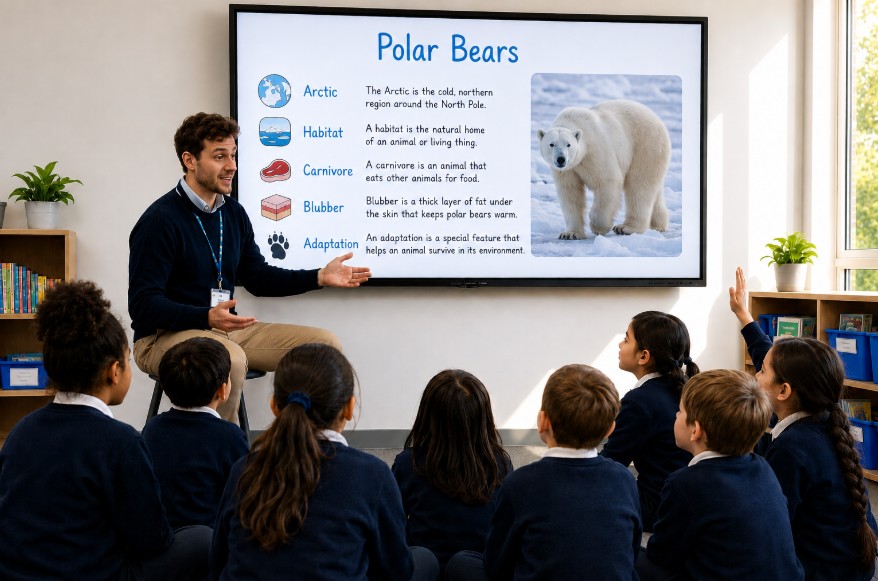
When children begin school, teacher talk and picture storybooks become new and powerful sources of vocabulary knowledge that can rapidly turbo charge vocabulary growth.
Storybooks that are used well in a purposeful and strategic way have the potential to immerse children in rich, unusual and academic style language that they would rarely encounter in everyday conversation.
Similarly, informational non-fiction texts can introduce specialised academic vocabulary linked to science, history, geography, and mathematics.
Importantly, children learn words through repeated exposure to those words through teacher talk, discussion of vocabulary words in text, fiction and non-fiction, exploration of background knowledge related to a text, and meaningful use of the new vocabulary word across different contexts.
When Semantic Word Knowledge is Not Strong
Children with developmental language disorder have difficulty building strong semantic networks, they may struggle to remember new vocabulary, have difficulty explaining new ideas clearly, overuse vague language such as that thing, stuff, or this one, etc.
Commonly seen behaviour in children with oral language difficulties is to misunderstand or not truly comprehend classroom instructions, struggle with reading comprehension of text they can actually decode and find it very difficult to retrieve words quickly during conversation.
These children do not simply forget words; the problem is related to the reality that difficult to recall words were often never securely connected to meaning networks.
If a child does not fully understand a new word, the brain has difficulty storing it efficiently in long-term memory. The word is never really learned and without spaced retrieval becomes easily forgotten and eventually lost.
This seeming inability to remember new and complex words or language creates a compounding problem in school settings. Much of classroom learning depends on student have robust vocabulary knowledge and healthy and expansive semantic word networks.
Every subject in a school curriculum has the potential to introduce new concepts, new labels, increasingly complex language and more interconnected word knowledge.

Why Strong Vocabulary Shapes Learning Success - Vocabulary Intervention
Effective vocabulary intervention is not really about teaching children to memorise isolated words. The goal here is to have a clear goal of teaching our students new vocabulary in a systematic way and create the architecture necessary to build rich networks of meaning in children's brains.
Children need repeated opportunities to: hear new words, discuss new vocabulary words, connect those words to background knowledge, compare new words with similar words or synonyms, and be able to use new words competently in the correct context in conversation.
When vocabulary teaching focuses on meaning and connection between words and building complex semantic word networks, even children with developmental language disorders will be better placed to:
- understand complexity in texts
- remember new information
- organise ideas in a logical and meaningful way
- explain their thinking using full sentences
- participate confidently in teacher led classroom discussion
- comprehend much more of what they read
Why Strong Vocabulary Shapes Learning Success - Shared Reading and Vocabulary Intervention
One of the most effective ways to build semantic word knowledge is through shared book reading.
Shared reading encourages teachers to pause during a reading or when asking students questions, explain words naturally, link ideas to prior knowledge, and model rich language in meaningful contexts.
A well-crafted picture book story with rich language can expose children to:
- sophisticated vocabulary
- complex sentence structures
- figurative language
- narrative organisation
- emotional language
- world knowledge
Importantly, books that are used in a strategic and purposeful way provide the necessary context for learning to take place.. Words often become easier to comprehend and remember when they are connected to characters, events, emotions, and experiences. in the story.
This is why conversation after an oral language reading session matters just as much as the book itself.
Responsive discussion, explanation, and repeated exposure help transform new and unfamiliar vocabulary words into meaningful knowledge that children can store in long term memory that can eventually be used independently and with confidence
References
Paul R. (2001) Language Disorders from Infancy through Adolescence: Assessment and Intervention. Mosby
Wallach, G.P. (2008) Language Intervention for School-Age Students: Setting Goals for Academic Success. Mosby Elsevier
All images on this page created with an iterative process via chatGPT.
Content Revised 05/2026


