What is Speech?
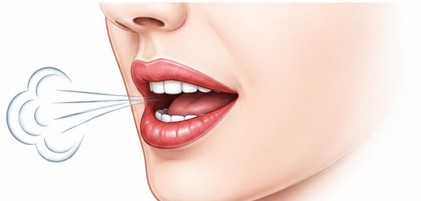
Speech is one of the most complex and remarkable things humans do. In a fraction of a second, the brain coordinates breathing, voice, movement, timing, and sound production so that we can communicate ideas, emotions, questions, and experiences.
Although speech often feels effortless, it relies on the precise coordination of several body systems working together continuously.
To understand how speech works, it helps to begin with the respiratory system.
What is Speech - the Respiratory System
The Respiratory System: The Power Source for Speech
Speech begins with breath.
The respiratory system provides the airflow that powers spoken language. When we breathe out, air travels upward from the lungs through the trachea (windpipe) and into the larynx, sometimes called the voice box.
Without a steady stream of airflow from the lungs, speech would not be possible.
The breathing we optimize for speech is different from the quiet type of breathing we might use when resting.. During everyday breathing, inhaling and exhaling occur in a fairly regular rhythm.
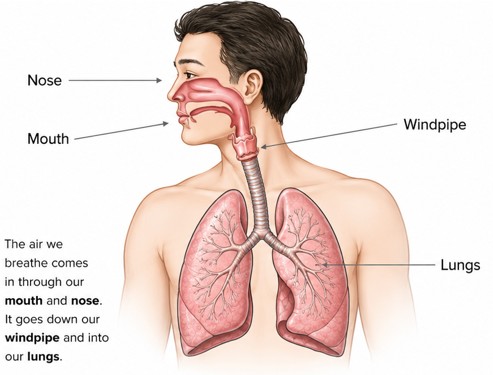
During speech, however, we take quick breaths in and control the release of air as we speak. This controlled airflow allows us to produce long sentences, change our volume, and emphasise important words.
The respiratory system acts as the foundation of speech production. It supplies the energy needed for the next stage of the process: phonation.
What is Speech - Phonation
As air moves through the larynx, it passes between two small bands of muscle called the vocal folds. The vocal folds sit inside the larynx and can move apart or come together depending on whether we are breathing quietly, speaking, whispering, or singing.
When the vocal folds come together and air passes through them, they vibrate rapidly to create sound. This process is called phonation.
The vibration of the vocal folds transforms quiet airflow from the lungs into voiced sound. The larynx can make these changes incredibly quickly and automatically. For example, it can rapidly switch between:
voiced sounds such as /b/, /d/, and /z/
voiceless sounds such as /p/, /t/, and /s/
Most people are completely unaware of these rapid adjustments because the speech system operates so efficiently.
The larynx also helps control:
pitch (how high or low a voice sounds)
loudness (volume)
vocal quality
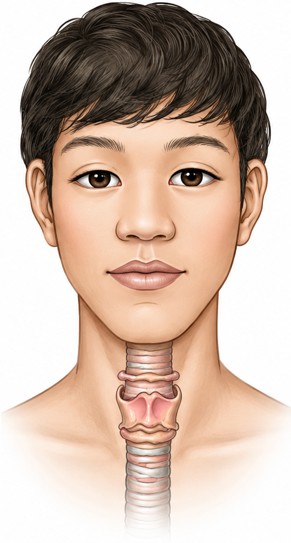
Together, the respiratory and phonatory systems create the sound source for speech. However, these sounds still need to be shaped into meaningful speech sounds. As air travels from the lungs and passes through the vocal folds, it creates the raw acoustic energy that powers spoken language.
The respiratory system provides the steady airflow needed to sustain speech, while the phonatory system controls voice quality, loudness, and pitch. Small changes in airflow pressure or vocal fold movement can dramatically alter how speech sounds.
Without coordinated breathing and voicing, spoken communication would sound weak, strained, monotone, or difficult to understand.
What is Speech - Articulation
Articulation: Shaping Speech Sounds
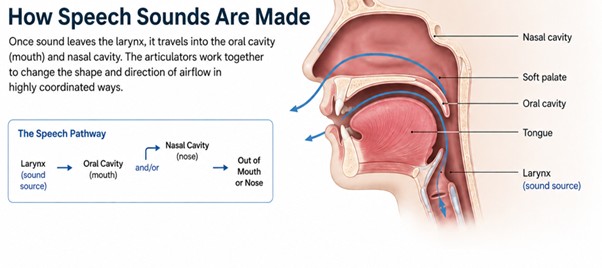
Articulation refers to the precise movements of the tongue, lips, jaw, teeth, palate, and velum (soft palate) that shape airflow into recognisable speech sounds.
Once sound leaves the larynx, it travels into the oral cavity (mouth) and nasal cavity. Here, the articulators work together to change the shape and direction of airflow in highly coordinated ways.
For example: the lips come together to produce sounds such as /p/, /b/, and /m/
the tongue touches the alveolar ridge behind the teeth to produce sounds such as /t/, /d/, and /n/
the back of the tongue lifts toward the soft palate to produce sounds such as /k/ and /g/
These movements happen with extraordinary speed and precision. During normal conversation, a person may produce well over one hundred speech movements every minute, often without consciously thinking about them.
Articulation must also work in close coordination with breathing and voicing systems. Tiny changes in timing can completely alter the speech sounds we hear. The human speech system manages these adjustments almost instantly.
Consonants and Vowels
Speech sounds are generally divided into two broad categories: consonants and vowels.
Consonants
Consonants are produced when airflow is interrupted, restricted, or shaped by the articulators. Different consonant sounds are created depending on:
where the airflow is blocked or narrowed
how the airflow is changed
whether the vocal folds are vibrating
For example:
/p/ is produced by briefly stopping airflow with the lips
/s/ is produced by forcing air through a narrow space near the teeth
/m/ is produced by directing airflow through the nose
Vowels
Vowels are produced differently. Instead of blocking airflow, vowels are created with a relatively open vocal tract. The tongue changes position inside the mouth to shape different vowel sounds.
For example, the tongue sits high and forward for the vowel in see and lower and farther back for the vowel in car.
Vowels carry much of the loudness and resonance of speech and are essential for syllables and word structure.
Speech Requires Coordination
Speech is not produced by one single structure. It relies on the smooth coordination of multiple systems working together:
respiration provides airflow
phonation creates voice
articulation shapes speech sounds
resonance modifies sound quality
the brain plans and coordinates movements for speech
All of these systems must work together with remarkable timing and accuracy. In fact, speech is considered one of the most complex motor activities humans perform.
Children spend many years gradually learning to coordinate these systems effectively. As speech develops, some children may experience difficulties producing certain sounds clearly.
These speech sound errors are common during development, but some children require additional support to learn accurate speech production patterns.
Revision Update 05/2026


