Why Social Communication Matters
at School
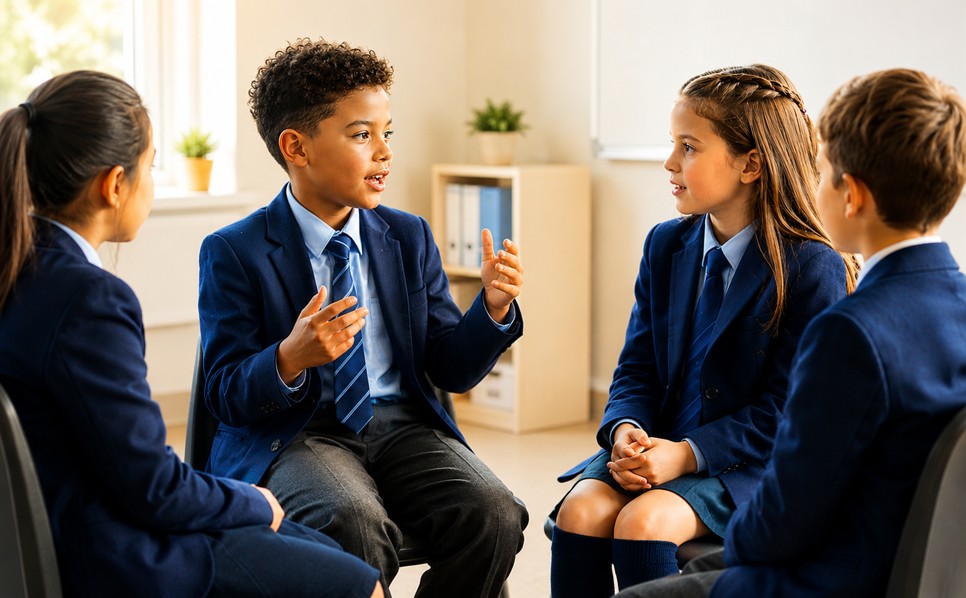
Why social communication matters at school:
Pragmatics refers to the social use of language. It is how children use words, sentences, facial expressions, gestures, tone of voice and body language to connect with other people.
Social communication helps children to share ideas with the classroom teacher and peers, join in play, understand social rules, have the capacity to comprehens and repair misunderstandings that arise, and actively participate in classroom learning.
In the early years of school, pragmatic and social language demands can become increasingly more complex. Children are expected to listen in groups, take turns before responding, follow classroom routines, work with their peers on group work, explain their thinking when prompted, and retell events from their own lives.
When social communication is not fully formed or is difficult due to autism or oral language disorder, a child can appear rude, inattentive, withdrawn, bossy, disruptive or immature, when the underlying difficulty may be an oral language-basis.
Social communication difficulties can quickly scuttle developing friendships, lead to decreased classroom participation, and spike behavioural outbursts due to not comprehending social rules.
Many school tasks require children to infer meaning, understand the perspectives of others, interpret nonliteral language such as metaphor, simile and be skilled in using oral language flexibly in multiple social contexts.. Understandibly, much can go askew.
The ASHA information on social communication notes that social communication involves pragmatics, social interaction, social understanding and language processing.
The ASHA also notes that difficulties with social language and social conventions difficulties affect conversational turn-taking, the abilty to recount stories, impact higher order thinking skills such as inference, and make nonverbal communication such as body language an enduring mystery.
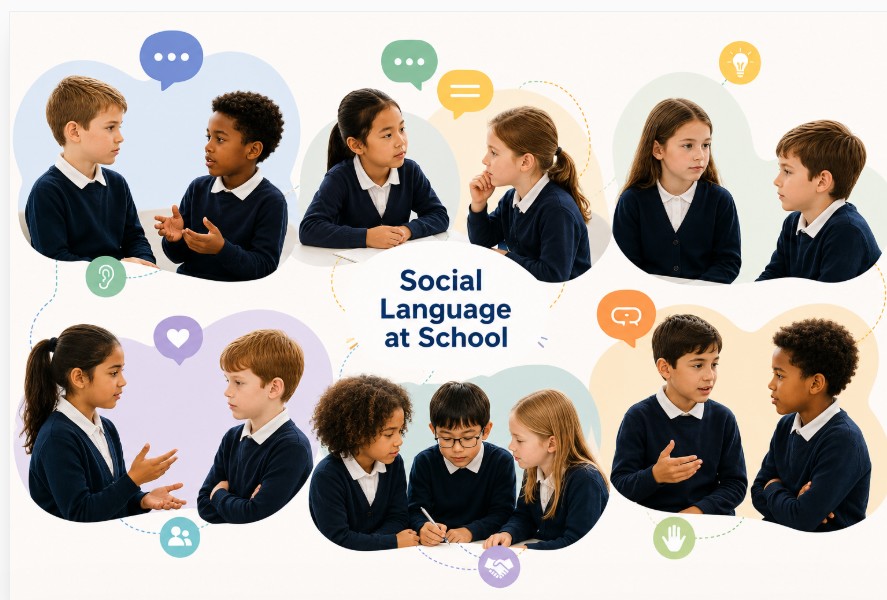
Why Social Communication Matters at School - What it Can Look Like
What Social Communication Difficulties May Look Like:
- A child with oral pragmatic language difficulty may have trouble: starting, joining or maintaining conversations, taking turns in conversation or staying on topic
- Children with pragmatic language problems struggle to adjust their language for different people or varied settings
- Uderstanding facial expression, gesture or tone of voice
interpreting jokes, sarcasm, idioms or implied meaning can be difficult with children with social language impairment. - understanding what another person may be thinking or feeling
- repairing communication breakdowns
- playing cooperatively or negotiating with peers
Social language difficulties may occur on their own or alongside autism, ADHD, developmental language disorder, acquired brain injury, trauma histories or behavioural and emotional difficulties.
This does not mean every child with these diagnoses has the same social communication profile. Assessment should always consider the child’s language, culture, personality, learning history and everyday environments.
Why Social Communication Matters at School - Assessment of Pragmatic Language
Assessment should be functional and collaborative. Social communication norms vary across families, cultures and communities, so a child who demonstrate s social language difference should not automatically be interpreted as having a potential pragmatic language disorder.
A comprehensive assessment may include:
1. Parent
and teacher interview
This helps identify how a child communicates at home, in the classroom with the teacher and peers, in
the playground and with unfamiliar people.
2. Classroom and playground
observation
Classroom observations are a view into how a child manages real interactions in a busy classroom setting, not just in 1-1 test
situations.
3. Language assessment
The child's vocabulary knowledge, undrstanding of sentence structure, oral comprehension of complex language, understanding of narrative language and inferencing should be considered and investigated.
4. Conversation and narrative
sampling
The speech pathologist may analyse a child's undrstanding of turn-taking, topic maintenance, story
organisation, repair strategies and clarity of expression.
5. Pragmatic language
checklists or rating scales
These are very useful to generate lots of information about a child. Parents or teachers gather information from adults who know the child well.
6. Dynamic assessment
The adult teaches, prompts or models a skill, then observes how the child
responds. This is useful for planning intervention.
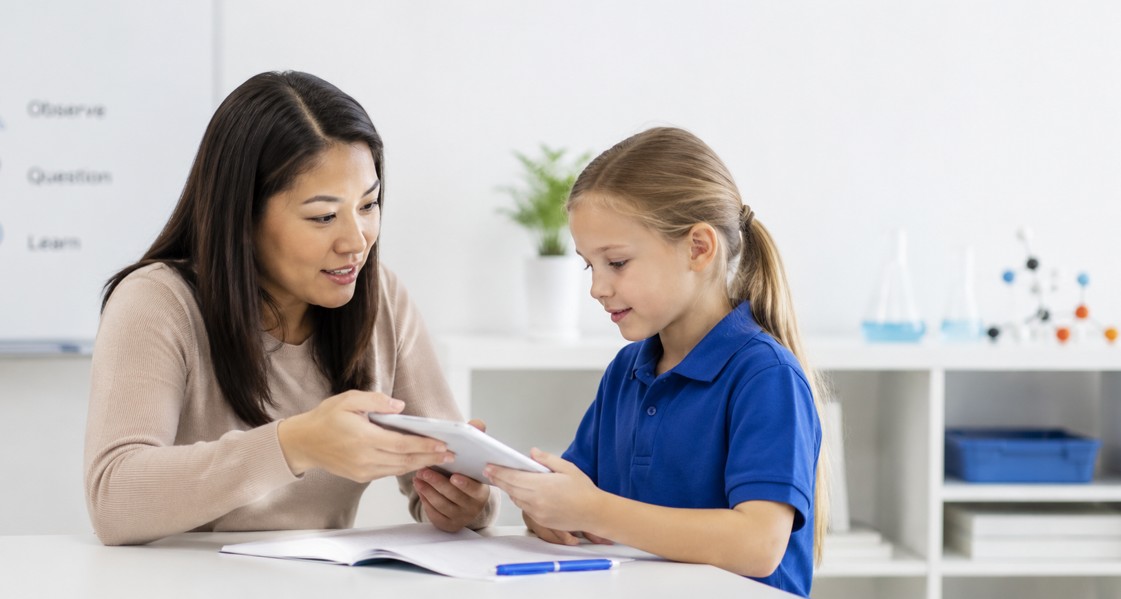
Why Social Communication Matters at School - Social Language Interventions
This page will focus on some of the best evidence based methods of helping children with pragmatic language difficulties to do better socially and is part of the reasoning for why social communication matters at school..
The following recommendations is not an exhaustive list but does show that there are a number of interventions which can be seen as reliable. Links to more information is in the description for each intervention.
1. Social Communication Intervention Project
The Social Communication Intervention Project (SCIP) is a structured intervention designed specifically for school-age children with pragmatic and social communication difficulties. The approach targets three major areas: social understanding, pragmatic interaction skills and language processing. Children are explicitly taught how to interpret social and emotional cues, manage conversations, understand implied meaning and improve narrative organisation. Intervention often includes role play, visual supports, structured discussion and guided reflection on social interactions. SCIP is particularly valuable because it combines direct teaching with opportunities to practise skills in meaningful social situations.
2. Peer-Mediated Intervention
Peer-mediated intervention involves teaching typically developing peers how to support and encourage social interaction. Peers may learn strategies such as inviting a child into play, modelling conversation, encouraging turn-taking or helping maintain interaction during group activities.
This approach is especially effective because children often learn social communication skills more naturally with classmates than with adults alone. Peer support can improve inclusion, confidence and participation across classroom and playground settings while helping children generalise skills into everyday situations.
3. Teacher-Mediated Classroom Support
Teachers play a critical role in supporting pragmatic language throughout the school day. Classroom intervention may involve modelling appropriate conversational language, explicitly teaching social expectations and providing structured opportunities for interaction.
Teachers can support children during partner talk, cooperative learning, shared reading, oral retells and problem-solving discussions. Visual prompts, sentence starters and guided questioning can help children organise their responses and participate more successfully.
Teacher-mediated support is most effective when pragmatic goals are embedded naturally within everyday classroom routines rather than taught in isolation.
4. Video Modelling
Video modelling uses recorded examples of successful social interaction to explicitly teach communication skills. Children watch short videos demonstrating target behaviours such as greeting others, joining a game, maintaining conversation, solving disagreements or repairing communication breakdowns.
The child then practises the skill with adult support and feedback. Video modelling can reduce cognitive load because children can repeatedly observe the same interaction in a clear and predictable format.
It is often highly engaging for children and can be particularly useful for teaching subtle social behaviours such as facial expression, body language and conversational timing.
5. Social Scripts
Social scripts provide children with clear and structured language for common social situations. Scripts may include phrases for greeting others, asking to join an activity, requesting help, sharing ideas or resolving conflict appropriately. Initially, scripts are often taught explicitly using visual supports, role play and repeated practice. Over time, adult support is gradually reduced so the child begins using the language more independently and flexibly. Social scripts can reduce anxiety in unfamiliar situations and help children develop more confident and organised communication patterns.
6. Comic Strip Conversations
Comic strip conversations use simple drawings and written dialogue to help children analyse and understand social situations. The visual format slows interactions down and allows children to examine what people said, did, thought and felt during an exchange. Adults can use speech bubbles, thought bubbles and simple sketches to explore misunderstandings, emotional reactions and problem-solving strategies. This approach is particularly useful for children who struggle to interpret hidden social meaning or perspective-taking. Comic strip conversations also encourage reflection and discussion in a supportive and non-threatening format.
7. Social Stories™
Social Stories™ are structured narratives designed to help children understand social situations, expectations and possible responses. The stories are written in simple and supportive language and often describe where a situation occurs, who is involved, what others may be thinking and what behaviours may be helpful. Social Stories™ are commonly used to prepare children for challenging situations such as transitions, group work, playground interactions or changes to routine. When combined with discussion and practice, they can improve predictability, reduce anxiety and strengthen social understanding.
8. Social Skills Groups
Social skills groups provide structured opportunities for children to practise communication with peers in a supported setting. Groups typically focus on skills such as turn-taking, topic maintenance, listening, cooperation, emotional regulation and problem solving. Activities may include games, role play, collaborative tasks and guided discussion. Effective groups move beyond rote social rules and instead help children understand the thinking behind successful interaction. Social skills groups are often most successful when linked closely to real classroom and playground situations so that children can apply new skills more independently.
9. Narrative Intervention
Narrative intervention helps children improve both social understanding and oral language organisation through storytelling. Children are explicitly taught story grammar elements such as setting, characters, initiating event, problem, feelings, actions and resolution. Narrative work supports pragmatic development because children learn how to explain events clearly, interpret character motivation and understand cause-and-effect relationships. Oral retells, shared story construction and discussion of character emotions can also strengthen inferencing and perspective-taking. Strong narrative skills are closely linked to later reading comprehension and written language success.
10. Explicit Teaching of Inferencing and Perspective-Taking
Many children with pragmatic language difficulties struggle to interpret what other people are thinking, feeling or implying. Explicit teaching of inferencing and perspective-taking helps make these hidden social processes more visible. Adults may use photographs, stories, videos or classroom scenarios to model how to interpret facial expression, tone of voice, body language and context clues. Children are guided to think about questions such as: What might this person be feeling?, Why did they react that way? or What does the speaker really mean? This approach strengthens comprehension, empathy, conversation skills and social problem solving.
Why Social Communication Matters at School - Final Thoughts
In conclusion why social communication matters at school is becuase social situations require children to understand others, interpret social conventions, and respond flexibly across different contexts.
When these skills are difficult to develop and access, the impact on children's lives can extend beyond just mere conversation to influencing friendship breakdowns, and be a source of reduced classroom participation.
With supportive, evidence-based intervention and meaningful opportunities for practice, children can strengthen their social understanding and communication confidence over time.
The ultimate goal is not perfection in social interaction, but helping children feel understood, included and capable of building positive relationships across everyday life.
References
Adams, C., Lockton, E., Freed, J., Gaile, J., Earl, G., McBean, K., ... & Law, J. (2012). The Social Communication Intervention Project: A randomized controlled trial of the effectiveness of speech and language therapy for school-age children who have pragmatic and social communication problems with or without autism spectrum disorder. International Journal of Language & Communication Disorders, 47(3), 233–244
Chan, J. M., Lang, R., Rispoli, M., O’Reilly, M., Sigafoos, J., & Cole, H. (2009). Use of peer-mediated interventions in the treatment of autism spectrum disorders: A systematic review
Bellini, S., & Akullian, J. (2007). A meta-analysis of video modeling and video self-modeling interventions for children and adolescents with autism spectrum disorders. Exceptional Children, 73(3), 264–287.
Charlop-Christy, M. H., Le, L., & Freeman, K. A. (2000). A comparison of video modeling with in vivo modeling for teaching children with autism
Fujiki, M., Spackman, M. P., Brinton, B., & Hall, A. (2004). The relationship of language and emotion regulation skills to reticence in children with specific language impairment. Journal of Speech, Language, and Hearing Research.
Goldstein, H., & Cisar, C. L. (1992). Promoting interaction during sociodramatic play.
Gray, C. (1994). Comic Strip Conversations. Future Horizons.
Gray, C., & Garand, J. (1993). Social Stories: Improving responses of students with autism with accurate social information. Focus on Autistic Behavior, 8(1), 1–10
Gresham, F. M., Sugai, G., & Horner, R. H. (2001). Interpreting outcomes of social skills training for students with high-incidence disabilities. Exceptional Children.
Justice, L. M., & Kaderavek, J. N. (2004). Embedded-explicit emergent literacy intervention I: Background and description of approach
Kamps, D. M., Leonard, B., Vernon, S., Dugan, E., & Delquadri, J. (1992). Teaching social skills to students with autism to increase peer interactions in an integrated first-grade classroom. Journal of Applied Behavior Analysis, 25(2), 281–288.
Kokina, A., & Kern, L. (2010). Social Story™ interventions for students with autism spectrum disorders: A meta-analysis.
Krantz, P. J., & McClannahan, L. E. (1993). Teaching children with autism to initiate to peers: Effects of a script-fading procedure. Journal of Applied Behavior Analysis, 26(1), 121–132.
All images developed via chatGPT and an iterative process.
Content Update 05/2026
Return from Why Social Communication Matters at School to What is Oral Language
