Why Oral Language Is the Invisible Software Behind Learning

Why oral language is the invisible software behind learning,
Oral language is like the brain’s operating system; it's quiet, always switched on, and is the central core of everything a child might experience in a classroom environment.
Ora language enables children to gather new information, while comprehending highly complex instructions. Oral language underpins all thinking and is behind every question a student might ask, links achild's personal insights with spoken words, often all at once, and with blinding speed.
To grasp oral language's true value, imagine typing an essay on a laptop that does not have Word, essentially no operating system.
The laptop's screen dutifully and reliably lights up, the hardware is present, yet the hardware has nothing to connect to. That is because the operating system relies upon the invisible software deep inside that manages all memory and coordinates the flow of facts and details.
In the same way, oral language, unseen but always present, links new thinking and meaning into a smooth, coordinated network.
When oral language is strong, new learnings can seem easy.
But when oral language is placed under too much strain, either due to an innate weakness or from simple overload, then even relatively simple tasks can become too much of a load to carry.
Why Oral Language is the Invisible Software Behind Learning - From Fragments to Meaning
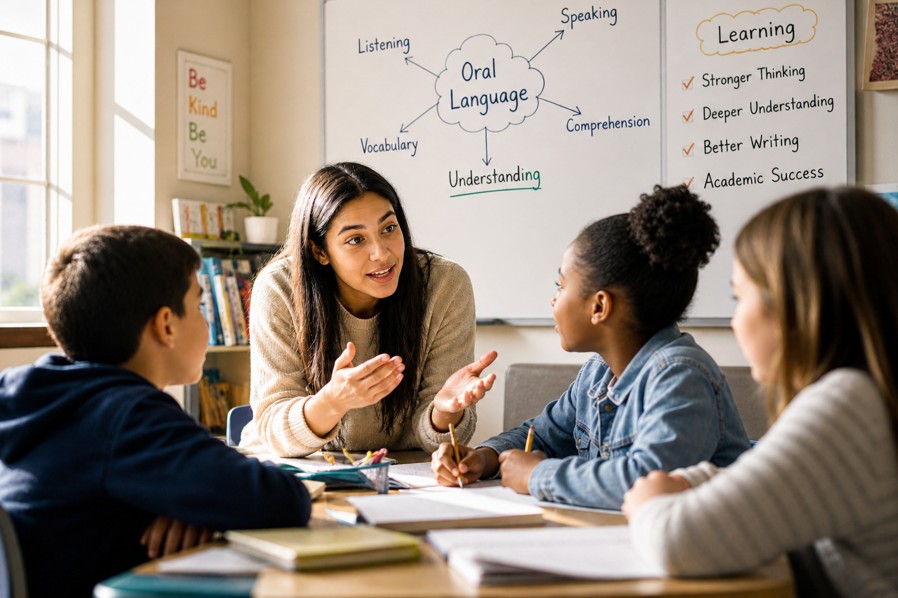
Oral language is what turns scattered pieces of divergent fragments of information taken in from our environment into a cohesive and connected whole.
Every act of reading, writing, and comprehension depends on the same underlying system that supports speaking and listening. This is why it is important to understand that literacy is embedded within the oral language system and draws upon it as it grows.
So why is oral language the invisible software behind learning?
Like a fluid operating system, oral language makes it possible for children to oversee multiple demands at once.
In the classroom, students hold information in working memory while first listening to teacher instructions, thinking about a possible response, and then responding verbally.
Oral language acts as a communication bridge that resides within our minds and links information between people.
Just as different parts of a computer, such as software linking with hardware, must work together, oral language links thought with expression, connects a child's prior knowledge to new learning, and supports both verbal and non-verbal communication between students.
Staying with our bridge metaphor, in this way, oral language is a bridge between students' own internal understanding of the world and to an external engagement with that same world.
This is a highly complex system that responds rapidly in real time.
Oral language is the underlying system that prompts children to not just think reflectively about their environment, but connect to their world in a shared, meaningful way, and engage in learning.
Why Oral Language is the Invisible Software behind Learning - Operating System Analogy
The operating system analogy becomes especially useful when we begin to look at what happens when the oral language “system” is placed under repeated strain with too much load.
A computer with a weak or overloaded operating system may still turn on, but programs freeze, commands are missed, information is lost, and tasks take far longer than expected. This of course becomes terribly frustrating.
Children with oral language difficulties often experience learning in a similar way.
The difficulty often lies in how language is processed, organised, and used in real times situations. An example might be how a child with receptive language difficulties is able to respond to teacher led, , language dense, conversation in the classroom.
The Instruction Bottleneck
A teacher says:
“Take out your maths book, turn to page 34, underline the heading, solve the first four questions, and then compare answers with your partner.”
Students with strong oral language skills might hear this series of instructions as single and coherent organised sequence.
A child with oral language difficulties who struggles to comprehend multiple strands of information due to reduced working memory capacity may retain only fragments:
- maths book
- page 34
- partner
By the time a student with receptive language difficulties locates the correct page, the rest of the instruction has disappeared from working memory.
What appears to teachers as forgetfulness or poor listening is often just a natural result of language and memory overload.
Operating system comparison:
The input was received by the operating system, but it could not process and store all commands simultaneously.
The Classroom Discussion Problem
During a class discussion, a teacher might ask his students:
"Why do you think the character, Max, changed his mind and decided to return home at the end of the story?”
A child with strong oral language can quickly retrieve vocabulary, organise thoughts, connect cause and effect, and form a coherent and reasoned response. It might sound like this:
'Max was lonely and he missed his mum nad he got bored on the island.'
In contrast, a child with oral language difficulty may actually know the answer internally but struggle to:
- organise thoughts into language
- find the right vocabulary
- construct a sentence quickly enough
- enter the conversation before it moves on
A child with oral language difficulty may say something like this:
“Because he just… you know… he didn’t want to anymore.”
The idea is there and is correct, but the child's oral language system cannot efficiently translate thinking into spoken words.
Operating system comparison:
The program exists, but communication between internal processing and external output is slow or unstable.

Writing that Seems Simple or Underdeveloped
A 12 year old boy with an oral language difficulty has recently learned and feels he understands the topic of photosynthesis.
The teacher has expertly led classroom discussion in a year 6 science class using explicit instruction. But despite the clear instruction, the child with oral language difficulties is only able to produce quite limited written work:
“Plants need water. They grow. The sun helps.”
The issue in this example is not the student's knowledge. The child has a clear idea of what he would like to write.
Instead, the student is struggling to:
- hold ideas in working memory
- organise sentences
- retrieve vocabulary
- build grammatical structure
- expand explanation language
Writing places enormous demands on oral language sysyem because when listening to complex spoken language, children must internally rehearse their oral language response before they can record it.
Operating system comparison:
Too many programs are running at once, causing slow performance.
Behaviour that Looks Like Inattention
A teacher explains a multi-step task in a year 7 science classroom.
Most students with strong oral language skills begin immediately with a clear purpose and understanding of what to do next, and the steps after that..
However, other children who may have working memory issues and and oral language impairment instead will wander, look around at what others are doing, fiddle with objects, or attempt to copy their peers.
These children may appear to be disengaged but may be in fact going through a quiet panic as they are simply unsure what they are required to do or able to mentally construct the logical steps to initiate a task.
To children with weak oral language skills, the classroom can become an unpredictable environment full of incomplete or even incomprehensible meaning.
Children with oral languge difficulties often cope by:
- watching others
- delaying action
- avoiding participation
- appearing oppositional
- shutting down
Operating system comparison:
The system received unclear instructions and cannot launch the correct response.
Why Oral language is the Invisible Software behind Learning - Final Thoughts
Oral language is like the invisible software that essentially runs the human brain in terms of how we interact with our environment.
Similarly to how computer software allows computer hardware to process information, oral language enables children to think, learn, remember, reason, and communicate.
Oral language underpins all acquistion of knowledge and is why oral language is the invisible software behind learning.
It supports and governs vocabulary knowledge, oral and reading comprehension, social interactions, reading, writing, and problem-solving.
Although it remains invisible and is difficulty for most people to visualise and comprehend, oral language powers every aspect of learning, making it one of the most important foundations for success in school and life.
All images from chatGPT following an iterative process.
Content Uploaded 05/2026
