Why Inquiry Learning Leaves Too Many Children Behind
Why Inquiry Learning Leaves Too Many Children Behind:
It starts, as it often does, with a good intention.
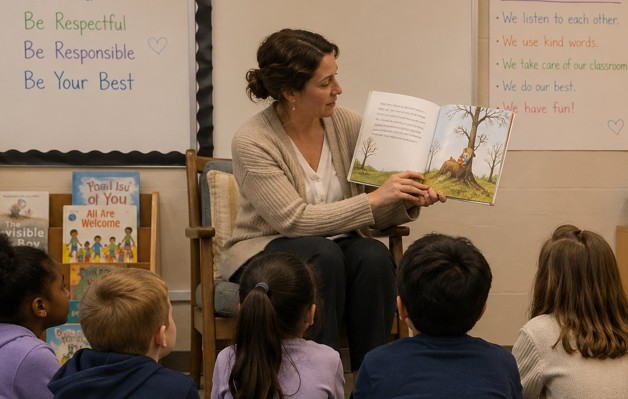
I’m observing from the back of a Year 1 classroom. The teacher has planned an inquiry lesson around a picture book, The Day the Crayons Quit. The questions she presents to the class are open, inviting, and well-meaning:
Before we continue, first a little about The Day the Crayons Quit for context.
The Day the Crayons Quit is a story that feels simple at surface level but becomes more endearing the longer you sit with it.
The story is very human and funny because the crayons are not just colours, they are fleshed out personalities with strong opinions, highly dubious workplace boundaries, and overly dramatic complaints.
Each crayon writes a letter to owner Duncan, bemoaning their lot in life and why they are the most overlooked, overworked or burnt out.
But let's return to the classroom...
While reading the text she turns her focus to the most under-appreciated crayon of them all: Red Crayon.
First question is...
“Why do you think red crayon says he is overworked?” Hands go up. A confident student offers the view that Duncan uses Red Crayon more than the other crayons. Such a good response and it inches open the door to explore Red Crayon's life and complaints.
The teacher's original question is fine, if a little broad. The child's response is well answered.
But then, nothing....
The teacher nods in agreement, smiles and then moves on to the next question which presumably is part of a pre-written list.
From a certain perspective, this exchange can look like rich learning. After all, the teacher asked a reasonably good open-ended question, and it was answered by a student.
Yet there is something missing here.
The teacher had an opportunity to explore the student's response with a number of scaffolded oral language techniques but didn't.
The moment has passed and a child's terrific response that could lead to a deep dive of Red Crayon's situation and fatigue and a strategic probe of the story's language and themes has passed unexplored.
Why Inquiry Learning Leaves Too Many Children Behind - Let's Explore

Over many years working as a school-based speech pathologist, I've learned to listen differently when in a classroom. I’m not just listening for which child is speaking. I’m listening for who isn’t speaking. I'm listening for the quality of oral language.
And I’m listening to the teacher’s questions and the phrasing of the teacher’s responses. Does the teacher have the skill to take the discussion in new directions? Is the teacher able to prompt students' thinking to explore, with the precision of a magnifying glass, embedded language that is inherent in most text?
An all-too-familiar pattern tends to emerge: a small group of articulate and competent students dominate the conversation. Other students may occasionally offer small fragments of information such as 'Red Crayon is tired.' Many say nothing at all.
Yes, the teacher led discussion moves forward, but not every student moves with it. Often students don't yet have the oral language competence to contribute at this level of teacher led classroom discourse.
More importantly, student thinking and oral expressive language is not being probed.
This is a shame.
Red Crayon has a number of concerns which vex him and it would be a terrific and fun thing for students in this class to be directed by the teacher to explore the book's many subtle human (crayon) foibles.
Why Inquiry Learning Leaves Too Many Children Behind - The Well-Intentioned Idea Behind Inquiry Learning

Inquiry-based learning has substantial roots in progressive education, influenced by thinkers such as John Dewey, who way back in the 1930’s argued that students learn best through experience and problem-solving.
Over the past 100 years or so, Dewey's ideas were further shaped and moulded by constructivist theorists such as Jean Piaget and Lev Vygotsky. In short, the main thrust of these influential thinkers is that learners actively build knowledge about their world.
This is such a compelling argument. Of course we want students to think, explore, and make meaning. But the problem is not the intention; it is the assumption that children can learn independently and unaided.
Inquiry learning shares a similar premise to the largely discredited whole-language idea that immersing kids in literacy and great children’s literature will inspire them to grow to love books and learn literacy.
The actual learning to read part is almost an afterthought and something kids will just have to learn as best they may.
Inquiry-based teaching as a bit like that.
Inquiry learning, particularly in its more open forms, makes the assumption that most early years students start school with solid oral languages and mature cognitive structures to guide their own learning with minimal scaffolding.
In early years classrooms, and especially for students with oral language difficulties, this assumption can lead to learning failure, particularly for many of our most vulnerable students.
Why Inquiry Learning Leaves Too Many Children Behind - What the Research Tells Us
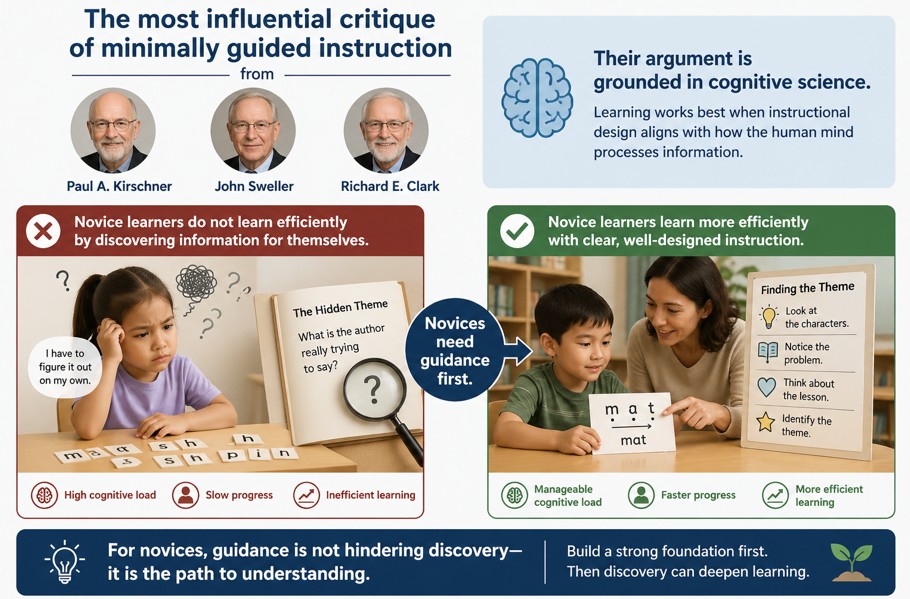
The most influential critique of minimally guided instruction comes from Paul A. Kirschner, John Sweller, and Richard E. Clark.
Their argument is grounded in cognitive science and sounds something like this: novice learners such as early years kids learning phonics for the first time or comprehending complex text or themes do not learn efficiently by discovering information for themselves.
Many students cannot do this because their background knowledge about unfamiliar subjects can often be quite small or their working memory systems becomes overloaded quickly and easily..
In simple terms, many of the young students we observe in early years classrooms do not have the oral language skills or the wherewithal to think deeply about content and information they do not yet understand, using language they do not yet have mastery of.
Advocates of inquiry-based learning do concede an important point: inquiry only works well when it is carefully scaffolded. And in far too many classrooms, it simply isn’t scaffolded to the level required
Why Inquiry Learning Leaves Too Many Children Behind - Summary
When classrooms rely heavily on open-ended inquiry, students with weaker language skills get fewer opportunities to practise their expressive oral language skills.
Our most vulnerable students may hear the language of the classroom but not be able to process it efficiently, comprehend the teacher's message nor contribute much to teacher led discussion.
In contrast, when teachers model, guide, and structure talk, every student has far greater opportunity to successfully process, comprehend and to explore their own use of oral language. This is where learning can accelerate for all learners.
The debate is often framed as a choice between teacher-led and student-led learning. But this is a false dichotomy.
The most effective classrooms are not those where teachers step back, but those where teachers are highly active, carefully selecting language, modelling thinking, and dynamically guiding students toward increasingly complex, detailed and competent responses.
This form of teaching and learning aligns with what we know from both research and practice: explicit instruction, followed by guided practice, leads to stronger outcomes than unguided exploration where the student is not adequately guided or instruction scaffolded at the level needed.
References
Kirschner, P.A. Sweller, J. & Clarke, R.E. (2010) Why Minimal Guidance During Instruction Does Not Work: An Analysis of the Failure of Constructivist, Discovery, Problem-Based, Experiential, and Inquiry-Based Teaching Educational Psychologist, 41(2), 75–86
Illustrations on this webpage have been created using OpenAI's ChatGPT image-generation tools, with creative direction, editing and selection by Speech Language Resources
Updated 04/2026
