The Limits of Inquiry Based Teaching
The Limits of Inquiry Based Teaching: Let’s start with something many teachers quietly feel but may not always say out loud.
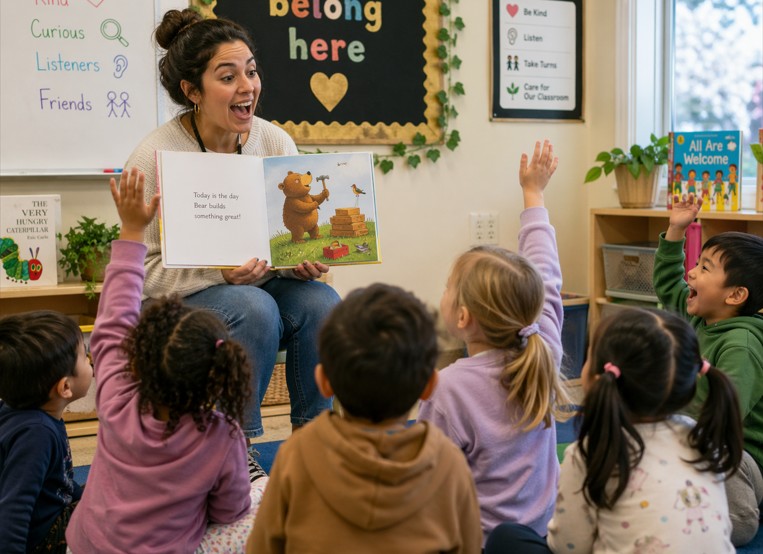
You run a lesson in your classroom. The students are talking and responding to your questions. Hands are going up. There’s discussion, ideas generated, movement. It looks like learning. But something nags at you.
The student responses are a bit thin. The same few students tend to always carry the conversation while others sit back, watching or opting out of the discussion entirely. You end the session thinking; The kids were engaged… but did they actually learn anything new?
If that sounds familiar, you’re not alone.

As a school speech pathologist, I see this pattern time and again. Not just in isolated classrooms, but across settings, year levels, and whole systems.
Teachers work incredibly hard, often using inquiry-based approaches that are widely encouraged by school and area leadership, yet still feel that something important is not landing for many students, particularly our most vulnerable learners.
The Limits of Inquiry Based Teaching - The Pros
Inquiry-based learning has given us some important reminders. Students should be prompted by classroom teachers to think. Students should be encouraged talk. They should be involved. These, of course, are worthwhile learning goals.
But somewhere along the way, the message shifted; it became blurred
Inquiry learning became less about guiding thinking and more about stepping back entirely. Teachers began to feel that they should talk less, that learning would naturally emerge if students were given space to explore and discuss a particular topic.
So, what do we often see in an inquiry learning classroom when exploring a topic or a story? Mostly open-ended questions that tend to go nowhere What do you notice? What do you think? And we hope that rich thinking and highly engaging oral language will follow
Sometimes it works.
Every classroom has that small group of students who already have the oral language and confidence to respond to vague or unstructured questions. But for too many others, particularly those children with oral language difficulties, there is never enough structure in the questions, nor the teacher directed opportunities to respond.

Let's explore an example text to illustrate this point.
Where the Wild Things Are, is a book almost every early years teacher knows. Wild Things is a deceptively simple story, but it carries rich and complex emotional ideas. Max is angry. He feels misunderstood. He escapes into imagination, where he gains control and power. Eventually, he returns home, where he feels safe and loved.
The ideas hinted at in Wild Things are not obvious to early years learners. Without the proper teacher directed oral language support, many students will not naturally arrive at the concepts hinted at in the text.
Your students need you need help to see beneath the surface of the texts meaning to the underlying complex themes.
The Limits of Inquiry Based Teaching - Not Just Collecting Guesses
In Where the Wild Things Are, Max has been sent to his room by his mother without supper. As classroom teacher, you might ask your students, "Why did Max get sent to his room?" One of your more confident students might respond, “Because he was naughty.” Another student might add, “He was in trouble.” In this situation many classroom teachers will simply acknowledge the student responses and move on to the next part of the story.
And it feels like a successful discussion. The students responded to the question you asked, the responses were correct, so the lesson continues.
But if we pause just for a moment, something important was missing from that teacher led discussion. The teacher's question, even though open-ended, was relatively simple.
The problem here is that the students' thinking was not prompted beyond the initial question and was relatively shallow. The opportunity to build deeper understanding and to explore student thinking has passed. In this instance one of the book's deeper themes is not explored.
Here is an uncomfortable truth that many teachers are beginning to recognise.
In these inquiry-based teaching moments, we are not really teaching meaning or exploring a book's deeper themes, we are often simply collecting student guesses.
There is too often a mismatch between what we are asking students to do and what they are actually able to provide.
Responding to even a simple question requires significant cognitive and linguistic effort. Students must first be familiar with and understand the text. They are also required to interpret meaning, connect ideas, organise their thinking, and express it in a spoken sentence, all in real time.
For many of our students, the cognitive load is too high.
Both student thinking and oral language must be explicitly taught modelled and ultimately shaped by the classroom teacher.
Most students can't get there on their own.
What goes unspoken about inquiry learning is this: thinking and meaning making is not something students simply produce with a few prompts.
A common breakdown of inquiry-based approaches is the assumption of student independence before they are ready for it.
The Limits of Inquiry Based Teaching - An Uncomfortable Truth
Here is an uncomfortable truth that many teachers are beginning to recognise.
In these inquiry-based teaching moments, we are not really teaching meaning or exploring a book's deeper themes, we are often simply collecting student guesses.
There is too often a mismatch between what we ask students to do and what they are actually able to provide in the moment.
Responding to even a simple question requires significant cognitive and linguistic effort from our most vulnerable learners.
Students must first be familiar with and understand the text. They are also required to interpret meaning, connect ideas, organise their thinking, and express it in a spoken sentence, all in real time.
The good news is that the solution is not complicated.
It doesn't demand hours of planning nor a significant change. It does however require a small but important shift in how you use teacher talk - how you both ask questions and respond to students' statements.
The Limits of Inquiry Based Teaching - Model the Language
Let's return to our example text once more - Where the Wild Things Are to illustrate what this can look like.
You begin this session by modelling your thinking before launching into asking several questions.
In the story, Max has been sent to his room.
It's important to model the language for your students. State things clearly: "Max got sent to his room because he acted like a wild thing. He lost his temper." Note that this is a statement to prompt student thinking.
You can then prompt your students' thinking with questions like this, “What might Max be feeling as he walks to his room? What makes you think that?”
The Limits of Inquiry Based Teaching - Summary
The key idea communicated on this page is the importance of providing highly structured teacher talk to transform students from guessing when responding to teacher questions to explore students thinking and comprehension.
When teachers explicitly model thinking and oral language, students will be better placed to learn how to express ideas, scaffolded and shaped by the classroom teacher.
This deliberate and strategic approach doesn’t replace inquiry it strengthens it. Teacher talk, used deliberately and with care, builds understanding and supports all learners, particularly our most vulnerable learners.
Without well-planned, strategic teacher talk, more confident students tend to dominate. With it, the teacher provides the scaffolding all students need to understand the text and express their ideas clearly, so that participation and success are not just limited to the most advanced learners.
Illustrations on this webpage have been created using OpenAI's ChatGPT image-generation tools, with creative direction, editing and selection by Speech Language Resources
Uploaded 04/2026
