Syntax and Oral Language the Framework for Learning

Syntax and Oral Language the Framework for Learning
Syntax is largely invisible during everyday conversation. We tend to notice it only when sentences sound confusing, incomplete, or difficult to understand.
When children speak in clear, organised sentences, syntax works silently in the background, helping thoughts unfold in a logical sequence. But when syntactical development is weak or delayed, communication can quickly become difficult. Ideas become fragmented, sentences may sound confusing or incomplete, and both speaking and comprehension can begin to break down.
In many ways,
syntax is the structural framework of oral language.
Just as the steel frame of a building supports walls, windows, and ceilings,
syntax supports spoken language. Vocabulary provides the individual words, but
syntax determines how those words are organised so meaning can be communicated
clearly.
Without syntax, language would simply be a collection of disconnected words.
A child might know hundreds or even thousands of words, but unless those words can be organised into meaningful sentence structures, communication remains limited. Syntax allows children to describe experiences, explain ideas, ask questions, tell stories, follow instructions, and participate successfully in classroom discussion.
Syntax and Oral Languge the Framework for Learning - Multi-Step Instructions
Importantly, syntax also
plays a major role in comprehension.
Children do not simply use syntax when speaking; they must also understand the syntactical structure of the sentences they hear and read. This is particularly important in school settings, where spoken and written language become increasingly complex across the years of schooling.
As students move through primary school, sentences become longer, denser, and more abstract. Teachers often give multi-step instructions using embedded clauses and complex sentence structures:
“Before you hand in your science project, make sure you’ve completed the final diagram that we discussed yesterday.”
To understand a sentence like this, a student must hold the sentence in working memory while processing its grammatical structure and meaning. Students with weak syntactical knowledge may lose track of important information before the sentence is complete.
This is one reason why syntax is so strongly connected to academic success.
Researchers such as Cheryl Scott have highlighted the close relationship between syntactical development, oral language comprehension, literacy, and classroom learning. Syntax helps students organise language efficiently, understand increasingly sophisticated texts, and communicate complex ideas with precision.

What Are Syntactical Rules?
Syntactical rules are the specific systems that govern how words are organised
into sentences.
These rules determine:
• the order of words within a sentence
• how phrases are constructed
• which combinations of words are grammatically acceptable
• how meaning changes depending on sentence structure
English syntax follows predictable patterns. Even very young children gradually learn these patterns through repeated exposure to spoken language.
For example,
English speakers instinctively know that the sentence:
“The dog chased the boy.”
sounds correct, while:
“Dog the boy chased the.”
does not.
Most fluent speakers are never formally taught many of these rules. Instead, syntactical knowledge develops slowly over years of listening, speaking, reading, and interacting with others.
Syntax and Sentence Structure
At its simplest level, a sentence requires two essential building blocks:
• a noun phrase
• a verb phrase
A noun phrase
contains a noun and the words that describe or modify it.
For example:
• the hill
• the green hill
• that enormous green hill
• the hill beside the river
A verb phrase
is built around a verb and explains the action or state within the sentence.
For example:
• laughed
• was laughing
• had been laughing
• might have been laughing
Even very
short sentences contain both elements.
“Sue laughed.”
This sentence is syntactically complete because it contains both a noun phrase
(“Sue”) and a verb phrase (“laughed”).
Now compare
that sentence with this example:
“The mysterious underground society of travellers from the forgotten northern
valleys beyond the mountain ridge.”
Although this
group of words sounds sophisticated, it is not actually a complete sentence.
Why?
Because it does not contain a verb phrase.
The sentence never tells us what happened.
The distinction matters.
Children with oral language difficulties can produce utterances with rich vocabulary but incomplete sentence structures. They may speak in long strings of descriptive language without clearly expressing the central action or idea.
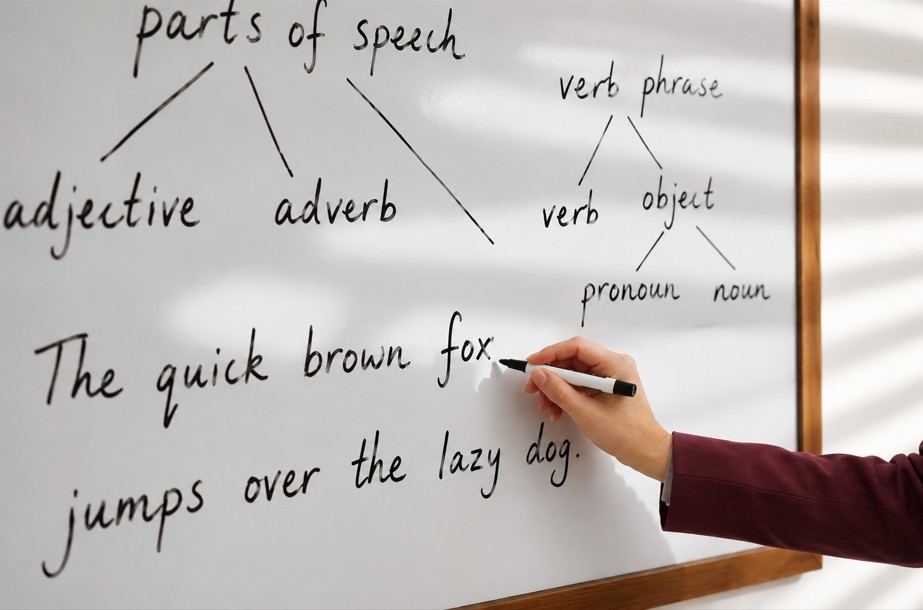
Syntax and Oral Language the Framework for Learning - Organises Thought
Syntax helps organise
thought.
It gives spoken language direction and coherence.
Syntax and
Oral Language Development
Syntax develops gradually over many years.
Young children typically begin with single words before combining two-word
phrases such as:
“Daddy go.”
“Want drink.”
“Big dog.”
Over time, these early combinations expand into increasingly sophisticated sentence structures. Children learn to use plurals, verb tense, pronouns, conjunctions, subordinate clauses, and more advanced grammatical forms.
Importantly,
syntactical development is not simply about producing correct grammar.
It is about learning to organise language efficiently enough to communicate increasingly complex ideas.
Strong
syntactical skills allow students to:
• explain their thinking clearly
• retell stories in sequence
• ask precise questions
• participate in classroom discussion
• understand academic language
• comprehend written texts
• produce organised written language
In many
respects, syntax acts as a bridge between oral language and literacy.
Children who struggle to understand complex spoken sentences often experience similar difficulties when reading. Written texts frequently contain syntactical structures that are far more complex than everyday conversation.
This is particularly true in upper primary and secondary classrooms, where textbook language becomes increasingly dense and abstract.
Syntax and Oral Language the Framework for Learning -Sentence
Types
There are four main sentence types commonly discussed in grammar instruction.
Simple
Sentence
Contains one main clause.
“The boy ran home.”
Compound
Sentence
Contains two main clauses linked by a coordinating conjunction.
“The boy ran home, and his sister followed behind him.”
Complex
Sentence
Contains a main clause and one or more subordinate clauses.
“After the storm ended, the boy ran home.”
Compound-Complex
Sentence
Contains multiple main clauses and at least one subordinate clause.
“After the storm ended, the boy ran home, but his sister stayed behind.”
As sentence
structures become more complex, the demands on oral language comprehension and
working memory also increase.
This is why explicit support for oral language development can be so important
for many students.
Syntax and Oral Language the Framework for Learning - Final Thoughts
Syntax is far more than
a set of grammar rules taught in school workbooks.
It is one of the foundational systems that allows human language to function.
Syntax helps children organise thought, communicate ideas, understand spoken language, follow classroom instruction, comprehend texts, and participate socially in the world around them.
When syntax develops strongly, communication becomes clearer, more organised, and more flexible.
When educators understand the powerful relationship between syntax, oral language, comprehension, and learning, they are far better equipped to support the language development of every student in the classroom.
References
Andrews, R. Torgerson, C. Beverton, S. Freeman, A., Locke, T., Law, G., (2006) The effect of grammar teaching on writing development. British Educational Research Journal, 32, 39-55
Merrick, D. (2009) Blake's Grammar Guide for Primary Students. Pascal Press
Scott, C.M. (2009) A Case for the Sentence in Reading Comprehension. Language, Speech and Hearing Services in Schools Vol 40, 184-191
All images created on chatGPT following an iterative process.
Updated 05/2026


