Sequence and Procedure Graphic Organisers for Writing

How to Use Sequence and Procedure Graphic Organisers for Writing
Sequence and procedure graphic organisers provide a framework for helping students plan for and effeciently communicate complex ideas via written expression.
Students with language and literacy difficulties may understand individual events or stages of a process but struggle to organise their knowledge into logically connected sentences and paragraphs.
Graphic organisers help reduce working memory demands by separating the organisation of information from the more complex demands of sentence construction, spelling and punctuation.
However, completing a graphic organiser is only the first stage. Students also require explicit instruction in how to transform organised information into coherent written texts.
Understanding the Difference Between Sequence and Procedure
Although sequence and procedure graphic organisers share similar visual structures, they serve different communicative purposes.
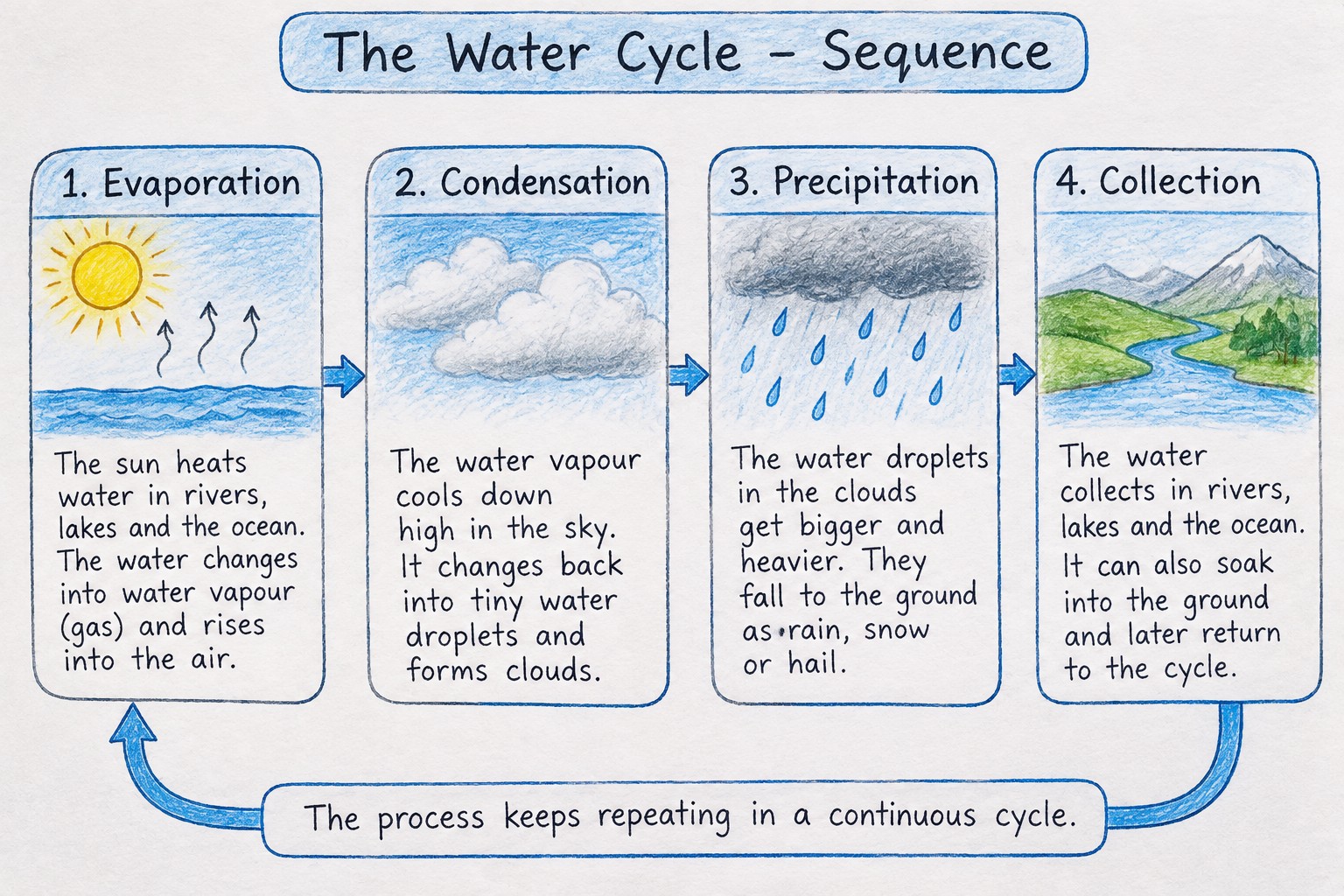
Sequence describes events or stages in the order in which they occur. Examples include explaining the water cycle, describing historical events or retelling a story.
Sequential explanations generally use declarative sentences that communicate information.
Water vapour cools and condenses into tiny droplets.
Procedure explains how to complete a task or achieve a particular outcome. Examples include conducting a scientific experiment, following a recipe or constructing a model.
Procedural writing frequently uses imperative verbs that instruct the reader to perform an action.
Pour equal amounts of water into two shallow dishes.
Both text structures require logical organisation. However, sequence explains what happens, whereas procedure instructs the reader what to do.
Sequence and Procedure Graphic Organisers for Writing - Support Written Expression
Why Graphic Organisers Support Written Expression
Writing requires students to coordinate several cognitive and linguistic processes simultaneously. Students must retrieve relevant knowledge, organise ideas, construct sentences and apply grammatical and punctuation conventions.
A graphic organiser provides an external visual reference that can reduce these competing demands.
Teachers can maximise its effectiveness by combining graphic organisers with explicit instruction in sentence construction, vocabulary, oral rehearsal and paragraph development.
The following five-step instructional sequence provides a practical approach.
Step 1 – Organise the Information
Begin by modelling how to identify and record essential information using short phrases rather than complete sentences.
Encourage students to check whether the information is accurate, logically ordered and sufficiently detailed.
Recording concise information allows students to concentrate on the content of their writing before attending to sentence construction.
Sequence and Procedure Graphic Organisers for Writing - Rehearse Orally
Rehearse Sentences Orally
Before asking students to write, demonstrate how brief notes can be transformed into complete spoken sentences.
Information from the organiser:
Sun heats surface water.
Orally rehearsed sentence:
The sun heats water on the Earth's surface.
Expanded sentence:
The sun heats water on the Earth's surface, causing some of it to evaporate into the atmosphere.
Teachers can model sentence expansions, introduce precise vocabulary and encourage students to repeat or adapt the modelled sentences.
Oral rehearsal provides students with opportunities to refine their ideas and grammatical structures before committing them to writing.
Explicitly Teach Temporal Connectives
Temporal connectives help students communicate the order of events and the relationships between them.
Teach these words according to their function.
Teaching Temporal Connectives
Teach these words according to their function.
| Function | Examples |
|---|---|
| Introducing a sequence | First, initially |
| Continuing a sequence | Next, then, subsequently |
| Relating events in time | Before, after, when |
| Completing a sequence | Finally, eventually |
Drawing on instructional approaches described in The Writing Revolution, teachers can provide sentence stems that require students to complete a meaningful relationship between events.
For example:
- After water evaporates, ...
- Before water droplets form, ...
- When water vapour cools, ...
Teachers should model appropriate responses on a whiteboard, including the placement of a comma after an introductory subordinate clause.
These activities encourage students to move beyond simply listing events towards expressing stronger relationships between ideas using complex sentence forms.

Sequence and Procedure Graphic Organisers for Writing - Coherent Written Text
Teachers should now demonstrate how individual sentences can be developed from a graphic organiser to form a coherent paragraph.
Worked example – The Water Cycle
Initially, the sun heats water on the Earth's surface, causing some of it to evaporate. As water vapour rises and cools, it condenses into tiny droplets that form clouds. When water droplets or ice crystals become sufficiently large, precipitation falls to Earth. Finally, water collects in rivers, lakes and oceans, and the cycle continues.
Contrast this explanation with procedural writing.
Worked example – An Evaporation Experiment
- Pour equal amounts of water into two identical shallow dishes.
- Mark the water level in each dish.
- Place one dish in sunlight and the other in shade.
- Compare and record the water levels after several hours.
Discuss how the purpose of each text influences its sentence structures, vocabulary and presentation.
Gradually Reduce Instructional Support
Students will require different levels of instructional support.
High support
Provide a completed graphic organiser, model complete sentences and provide visual sentence examples. Also, encourage students to rehearse each sentence orally before writing it.
Moderate support
Guide students to complete their own graphic organiser. Provide a selection of subordinating connectives and encourage students to independently construct and connect several complex sentences.
Independent
Students identify and organise relevant information, select appropriate vocabulary and sentence structures, and independently construct an explanatory paragraph or a set of procedural instructions.
Encourage students to review their writing for accuracy, logical organisation, grammatical completeness and clarity.
Click on the Student Worksheet Below to Download the Free Teaching Pack
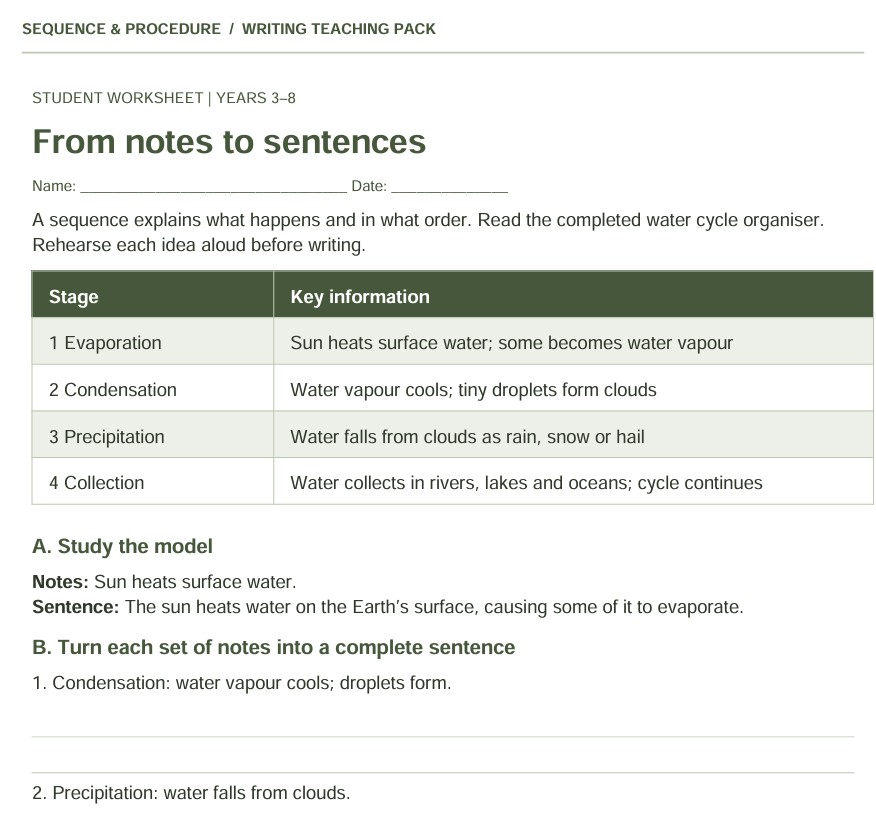
A completed graphic organiser is a highly efficient plan for writing. Students respond best to explicit teaching and repeated opportunities to transform brief notes into complete sentences. and sentences into meaningful, logically organised texts.
References
Hochman, J. C., & Wexler, N. (2024). The Writing Revolution 2.0: A Guide to Advancing Thinking Through Writing in All Subjects and Grades. Jossey-Bass.
Graham, S., et al. (2012). Teaching Elementary School Students to Be Effective Writers. Institute of Education Sciences.
Sweller, J., van Merriënboer, J. J. G., & Paas, F. (2019). Cognitive architecture and instructional design: 20 years later. Educational Psychology Review, 31, 261–292.
Illustrations on this webpage have been created using an extensive, iterative process on OpenAI's ChatGPT. Creative direction, editing and selection of final images was performed by SpeechLanguage-Resources
Return to Sequence and Procedure Graphic Organisers for Classroom Use
