Multiple Oppositions Therapy for Severe Speech Sound Disorders

Multiple Oppositions Therapy for Severe Speech Sound Disorders
Multiple Oppositions Therapy is an evidence-based speech sound intervention developed by Lynn Williams for children with moderate to severe phonological speech disorders. It is particularly effective for children whose speech is difficult for unfamiliar listeners to understand because they use one speech sound in place of many others.
Unlike traditional contrast approaches, which typically teach one sound contrast at a time, Multiple Oppositions Therapy introduces several carefully selected sound contrasts within the same intervention. By highlighting multiple contrasts simultaneously, the approach encourages broader reorganisation of a child's phonological system rather than focusing on isolated speech sounds.
The goal is not simply to teach four new sounds. It is to help children recognise that different speech sounds change the meaning of words, leading to meaningful improvements in speech intelligibility and everyday communication.
Multiple Oppositions Therapy for Severe Speech Sound Disorders - What is a Phoneme Collapse?
A phoneme collapse occurs when a child uses a single consonant sound to replace several different consonants.
For example, a child may use /t/ instead of /s/, /f/, /l/ and /tʃ/. As a result, the words sore, fore, lore and chore may all be pronounced as tore.
Although the child intends to say different words, the speech sound system no longer provides enough contrast for listeners to distinguish between them.
The more extensive the phoneme collapse, the greater its impact on speech intelligibility. Some children substitute one sound for ten or more consonants, while others present with several separate phoneme collapses across their speech system. In severe cases, much of what the child says may be difficult for unfamiliar listeners to understand.
A phoneme collapse reflects more than an incorrect speech sound. It indicates that the child's phonological system has lost important sound contrasts. Multiple Oppositions Therapy was specifically designed to rebuild these contrasts.
Multiple Oppositions Therapy for Severe Speech Sound Disorders - why a Phoneme Collapse Matters
Small differences between speech sounds help us tell words apart. Changing just one sound can create a completely different word.
For example:
tea – key
tie – sigh
toe – show
In this example, the word pairs listed differ by a single speech sound. Most children pronounce each word differently because the change in sound changes the meaning.
A child with a phoneme collapse may replace several different speech sounds with the same sound. For instance, a child might say "tea" for both tea and key, or "toe" for both toe and show.
As more consonant speech sounds are replaced by the same sound, more words begin to sound alike. This makes it increasingly difficult for unfamiliar listeners to understand what the child is trying to say.
Multiple Oppositions Therapy helps children discover that one speech sound should not represent many different words. By contrasting several sounds at the same time, the intervention encourages children to recognise and be aware that changing the first sound in a word changes the meaning of the word.
This increased awareness supports broader and lasting change throughout the child's phonological system.
How Multiple Oppositions Therapy Works
Traditional contrast approaches, such as Minimal Pairs Therapy, generally target one sound contrast at a time.
Multiple Oppositions Therapy takes a related but ultimately different approach. Children practise one error sound against up to four carefully selected target sounds within the same intervention cycle.
For example, let's say a child substitutes the /t/ phoneme for the /k/, /s/, /l/ and /tr/ phonemes.
Intervention would likely contrast words against the error /t/ in tea with words that feature the missing phonemes in the child's phonological speech system.:
tea – key
tea – sea
tea – Lee
tea – tree
The goal here is for the child to repeatedly hear, identifiy and practise the contrasting error /t/ with the target consonant phonemes - /k/ /s/ /l/ and /tr/ during structured intervention activities.
Children are prompted and shown the difference between what they intend to say with what they actually say. Children begin to recognise that by changing the initial sound in a word we are actively changing the word itself.
When we intend to say, "I had a cup of tea" but instead produce "I had a cup of sea," that it's important to say all speech sounds correctly so that were are consistently understood by listeners.
Over a period of several weeks or several months of targeted intervention, these repeated speech sound contrasts encourage broader reorganisation or essentially a reboot of the child's phonological system.
A central finding of multiple oppositions research is that as increasingly new sound contrasts become established in therapy, speech sound improvements extend well beyond just the words practised during intervention. Untreated error sounds and words spontaneously improve without treatment.
Powerful stuff..

Multiple Oppositions Therapy for Severe Speech Sound Disorders - Selecting Speech Targets
One of the strengths of Multiple Oppositions Therapy is its systematic approach to selecting intervention targets.
Target sounds are not chosen because they are the easiest to teach or because they typically develop first. Instead, clinicians analyse the child's unique error pattern and select sounds that are maximally different from the substituted sound.
Williams describes this process as using a distance metric.
The distance metric helps clinicians identify target sounds that differ from the child's substitute sound across several important speech features, including:
- place of articulation
- manner of articulation
- voicing
- major sound class
- single consonants versus consonant clusters
These larger differences create stronger phonological contrasts and are thought to have greater potential to reorganise the child's speech sound system.
Example of Speech Sound Target Selection
Imagine a child substitutes /t/ for the following sounds:
/p/ /f/ /l/ /r/ /s/ /k/ sl, st, tr blends
Rather than targeting every missing sound, the clinician may initially select:
/l/ /r/ /k/ /tr/
These sounds provide meaningful contrasts because they differ from the /t/ phoneme in several ways, including place, manner, voicing and complexity.
Selecting a small number of highly contrasting target sounds is considered more effective than teaching many similar sounds one by one.
Multiple Oppositions Therapy for Severe Speech Sound Disorders - Intervention
What Happens During Intervention?
After creating your therapy cards (this can take many hours - up to 60 cards for a theraoy session is common) activities can vary of course between clinicians, but multiple oppositions therpay generally follows a predictable, repeatable and quite simple sequence.
1. Introduce the Contrast Words
The clinician introduces the pictures and ensures the child understands each word before practising speech sounds.
2. Listening Activities
The child listens to the clinician say the words and identifies the correct picture. This builds awareness that different sounds represent different words.
3. Supported Production
The clinician models each target word while providing verbal, visual or placement cues as needed. The child practises producing the new contrasts.
4. Contrast Practice
The child repeatedly contrasts the substituted sound with the selected target sounds through structured games and communication activities.
5. Generalisation
As accuracy improves, practice gradually expands to new words, sentences and everyday conversation. The clinician monitors whether the new contrasts begin appearing in untreated words, indicating broader phonological change.
Who Benefits from Multiple Oppositions Therapy?
Multiple Oppositions Therapy is most appropriate for children who:
- have a moderate to severe phonological speech disorder
- present with one or more phoneme collapses
- have reduced speech intelligibility
- substitute one speech sound for several different consonants
- have a limited consonant inventory
- require broader phonological reorganisation rather than correction of one isolated speech sound.
Multiple Oppositions is perhaps less appropriate and useful for children who present with several isolated articulation errors.

Multiple Oppositions Therapy Guide

Click on the image to download the guide
The Multiple Oppositions Therapy for Severe Speech Sound Disorders guide offers tips and strategies on how to make inexpensive stimulus cards for therapy and features examples of sound contrast therapy techniques and sequences. The guide is also a practical introduction on how to begin multiple oppositions therapy.
Disclaimer: The Multiple Oppositions Therapy Guide is an entry level guide and a simplified practical introduction only. The guide is based on my own experience using multiple oppositions as a therapy model for severe speech disorders.
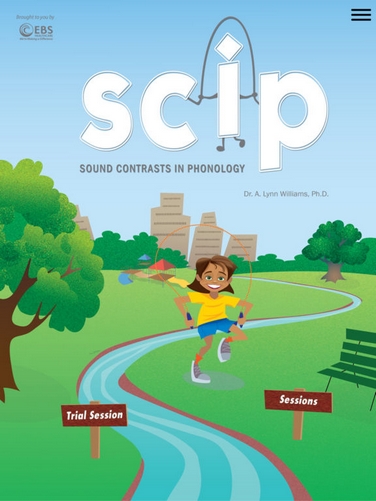
For an in depth description of multiple oppositions intervention theory and techniques, readers are encouraged to purchase Lynn Williams' SCIP program. The SCIP program features videos, recommended contrast therapy selection for specific speech errors, intervention techniques and over 2000 pictures of contrast sounds.
SCIP program available from iTunes.
SCIP (Sound Contrasts In Phonology) is the easiest way to increase intelligibility in less time. SCIP is an evidence-based, therapeutic tool developed through a one million dollar NIH grant by ASHA Fellow Dr. A. Lynn Williams. It allows you to both create and implement treatment approaches using five different contrastive therapy approaches:
- Multiple Oppositions
- Minimal Pairs
- Maximal Oppositions
- Treatment of the Empty Set
- Vowel Contrasts
SCIP includes more than 2,350 real words and 6,000 nonsense words to provide the widest variety of treatment stimuli and support rapid progress. The app allows individual or group sessions with up to 4 students. In group sessions, each student has individualized treatment targets and data collection.
Print or email graphs of treatment progress and individual session notes! Choose the option to treat word-initial or word-final sounds using pictures or illustrations. You can also print illustrations to prepare practice sets to be used away from the iPad or sent home for reinforcement. (Transcript in italics from iTunes SCIP webpage)
Click on the image to link to the iTunes SCIP webpage.
References
Bowen, C. (2009) Children's Speech Sound Disorders Wiley-Blackwell
iTunes Preview Page (2016) Text in italics and SCIP image from SCIP information page by EBS Learning
Williams, A.L. McLeod, S. & McCauley, R.J. (2010) Interventions for Speech Sound Disorders in Children Paul H Brookes Publishing Co
Williams, A.L. (2005) Assessment, Target Selection and Intervention: Dynamic Interactions Within a Systemic Perspective Topics in Language Disorders, Vol 23, No.3 pp-231-242
Williams, A.L. (2006) SCIP Sound Contrasts in Phonology: Evidence Based Treatment Program. User Manual Super Duper Publications
Williams, A.L. (2006) A Systematic Perspective for Assessment and Intervention: A Case Study Advances in Speech Language Pathology September 2006, pp 245 - 256
Updated 08/2026
Return from Multiple Oppositions Therapy to Minimal Pairs Theory
