How Graphic Organisers Support Oral Language and Reading Comprehension
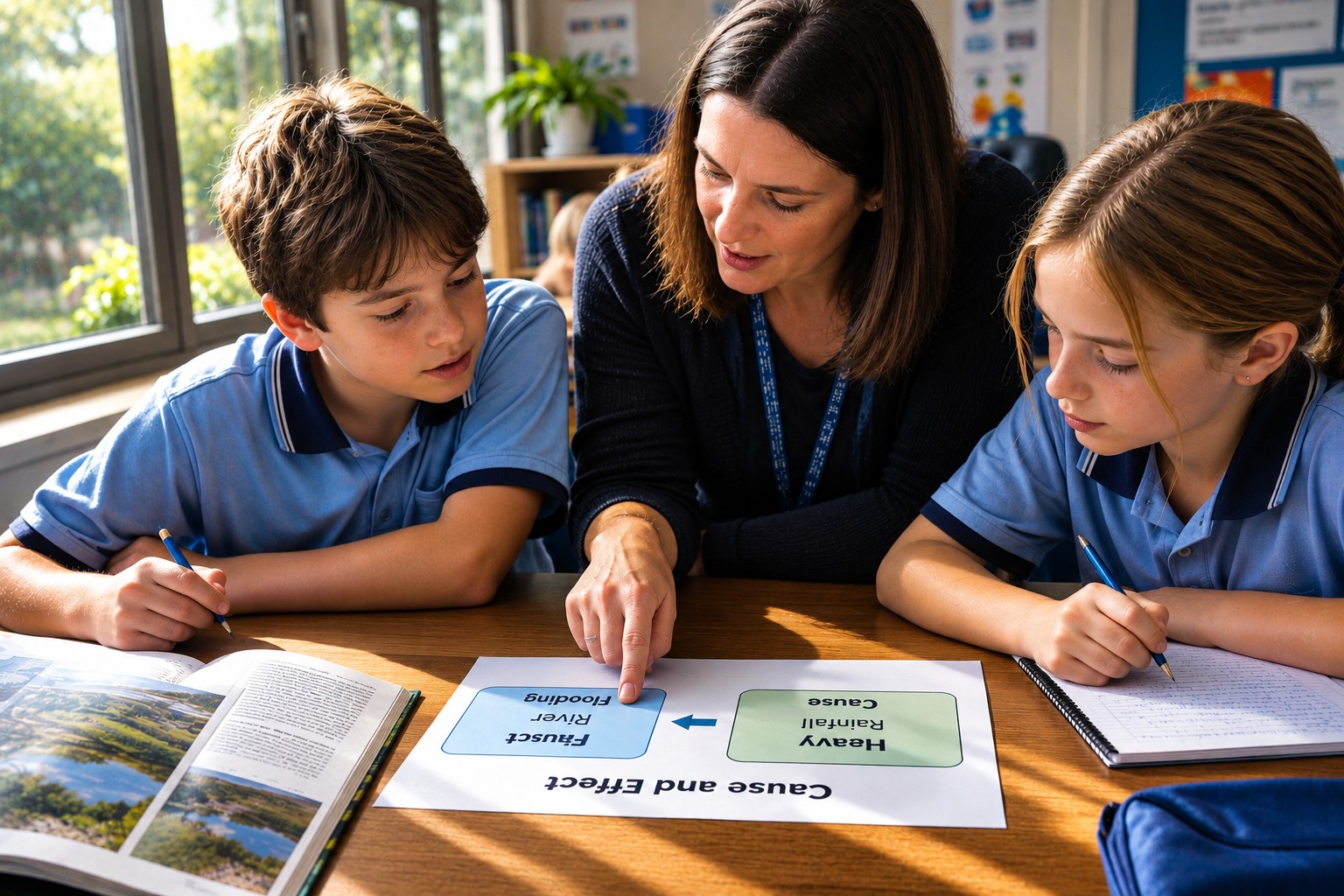
How Graphic Organisers Support Oral Language and Reading Comprehension.
Evidence-informed teaching strategies and free printable resources for Years 3–8.
Understanding More Than Just the Words
Reading comprehension involves considerably more than just accurately recognising words on the page. Students need to understand written information, identify key ideas and understand how ideas relate to each other.
This becomes increasingly important in Years 3–8, as students encounter more complex fiction texts, chapter books and also begin to encounter informational texts in science, history, geography and also in mathematics.
Many students can read fluently but continue to experience difficulty both comprehending and explaining what they have read.
Graphic organisers provide an important visual framework that helps students identify, organise and communicate complex information efficiently and well.
When combined with explicit teaching and structured discussion, graphic organizers are an effective visual tool that supports students' reading comprehension skills, while fostering their oral language development and written expression.
How Graphic Organisers Support Oral Language and Reading Comprehension -
What Are Graphic Organizers?
Graphic organisers are visual tools that represent information and show how ideas are connected.
They use boxes, arrows, diagrams and other simple visual symbols to make relationships within a text easier to recognise and understand.
A cause-and-effect organiser helps students understand what happened, why it happened, and what happened next.
In Where the Wild Things Are, Max behaves badly, so his mother sends him to bed without supper.
- Cause: Max misbehaves.
- Effect: His mother sends him to bed without supper.
A comparison organiser such as this helps students identify similarities and differences between two subjects.
Different organisers represent different and varied informational text structures, including sequence, description, comparison, cause and effect, and problem and solution.
Importantly, graphic organisers should not be treated nor perceived as being worksheets that students complete independently without adult instruction.
The true educational value of graphic organisers comes from the thinking, discussion and explanation they encourage as students develop and deepen their understanding of a particular text.
How Graphic Organisers Support Oral Language and Reading Comprehension -
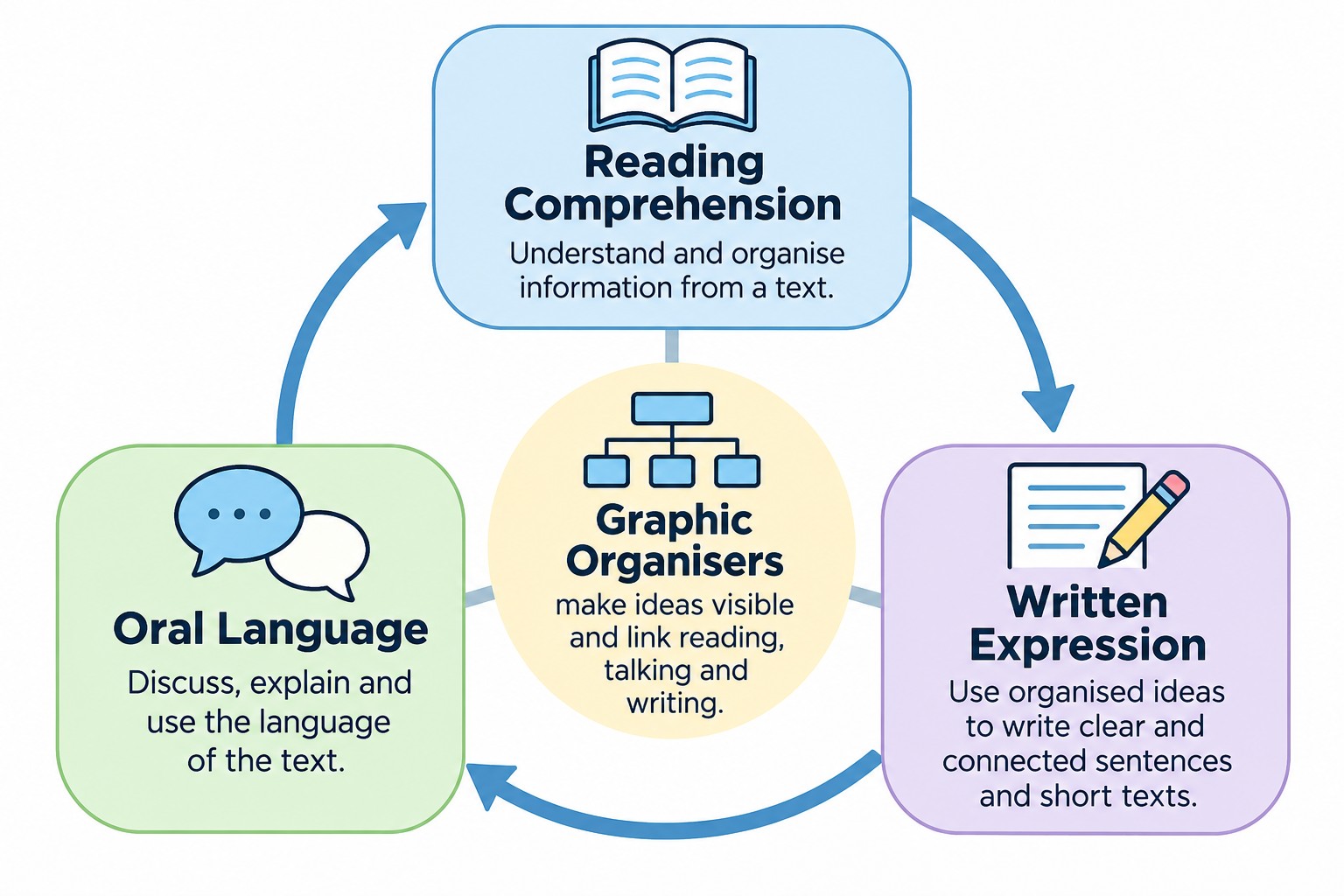
Graphic Organisers Lift Reading Comprehension Skills
Informational texts, also known as expository texts, contain many complex relationships that students need to recognise to adequately and accurately construct meaning. This is too often an assumed ability that children can do unaided.
A history text might explain the causes of an event. A science passage might describe a process, while a geography text might compare two environments.
Students who recognise these organisational patterns are better able to identify important information and understand how ideas fit together.
Graphic organisers can support this process in three ways.
First, they direct attention to important relationships. Students learn to look beyond isolated facts and identify connections between ideas.
Second, they make information visible. A diagram provides a stable representation that students can revisit while reading and discussing a text.
Third, graphic organizers support summarising. Students can use the completed organiser to identify central ideas without reproducing every detail.
Consider a passage explaining why a river flooded. A student might identify heavy rainfall as a cause and rising water levels as an effect. A graphic organiser makes that relationship far more explicit.
With repeated instruction, students can learn to recognise these structures across different texts and curriculum subjects.
How Graphic Organisers Support Oral Language and Reading Comprehension -
Nurtures Oral Language Development
Graphic organisers are particularly useful when students are expected to orally express their understanding of a text.
Many students can identify relevant information when prompted but have difficulty organising their thoughts into clear, connected sentences.
A completed organiser provides a visual reference that helps students formulate spoken explanations.
For example, a teacher might ask students:
“Why did the river flood?”
A student may initially respond:
“Lots of rain.”
The teacher can then model a more complete response:
“The river flooded because heavy rainfall caused the water level to rise.”
The visual structure provided by the graphic organizer provides an extra layer of scaffolded support as can be seen below in this simple example.
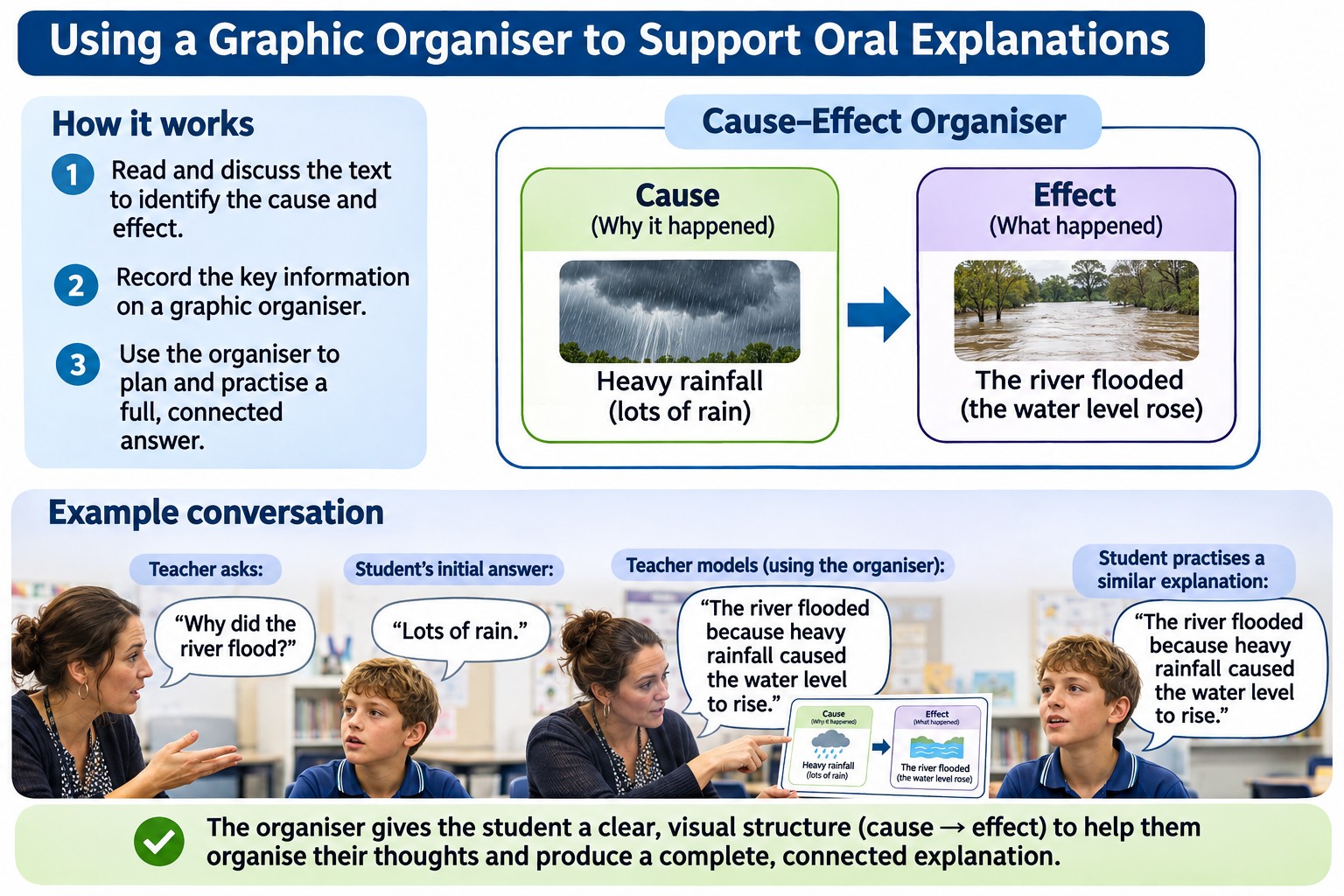
The student has a better chance of producing a similar explanation to what his teacher has scaffolded for him.
This teaching approach which is a type of direct instruction creates varied opportunities for teachers to explicitly teach vocabulary, sentence construction and connectives such as because, so, but, therefore, first and however.
Teachers and education support staff can use structured questioning, modelling, expansions and guided discussion to develop students’ oral language skills.
Graphic organisers provide an additional tool in the teacher’s toolkit, helping students organise their thinking and supporting the development of both oral language and reading comprehension.
The purpose of graphic organisers is not simply to complete several diagrams, but to provide a visual scaffold that helps students organise their thinking and communicate their understanding of a text with increasing independence.
How Graphic Organisers Support Oral Language and Reading Comprehension -
Connecting Oral Language to Written Expression
Writing requires students to organise their ideas and express them in clear, connected sentences. This can be challenging, particularly for students with language difficulties.
Graphic organisers make writing more manageable by helping students identify and organise important information before they begin.
For example, students might use a comparison organiser to explore the similarities and differences between a lion living in the African savannah and a polar bear living in the Arctic.
Students can record what the animals have in common, such as both being large, four-legged mammalian predators. They can then easily list important differences in the predators' habitats and their ways of hunting prey.
Using the completed organiser, students can first practise explaining these relationships aloud:
“Both lions and polar bears are predators, but lions live in warm grasslands while polar bears live in the cold Arctic.”
Students can then use their spoken explanations to construct written sentences or a short comparative paragraph.
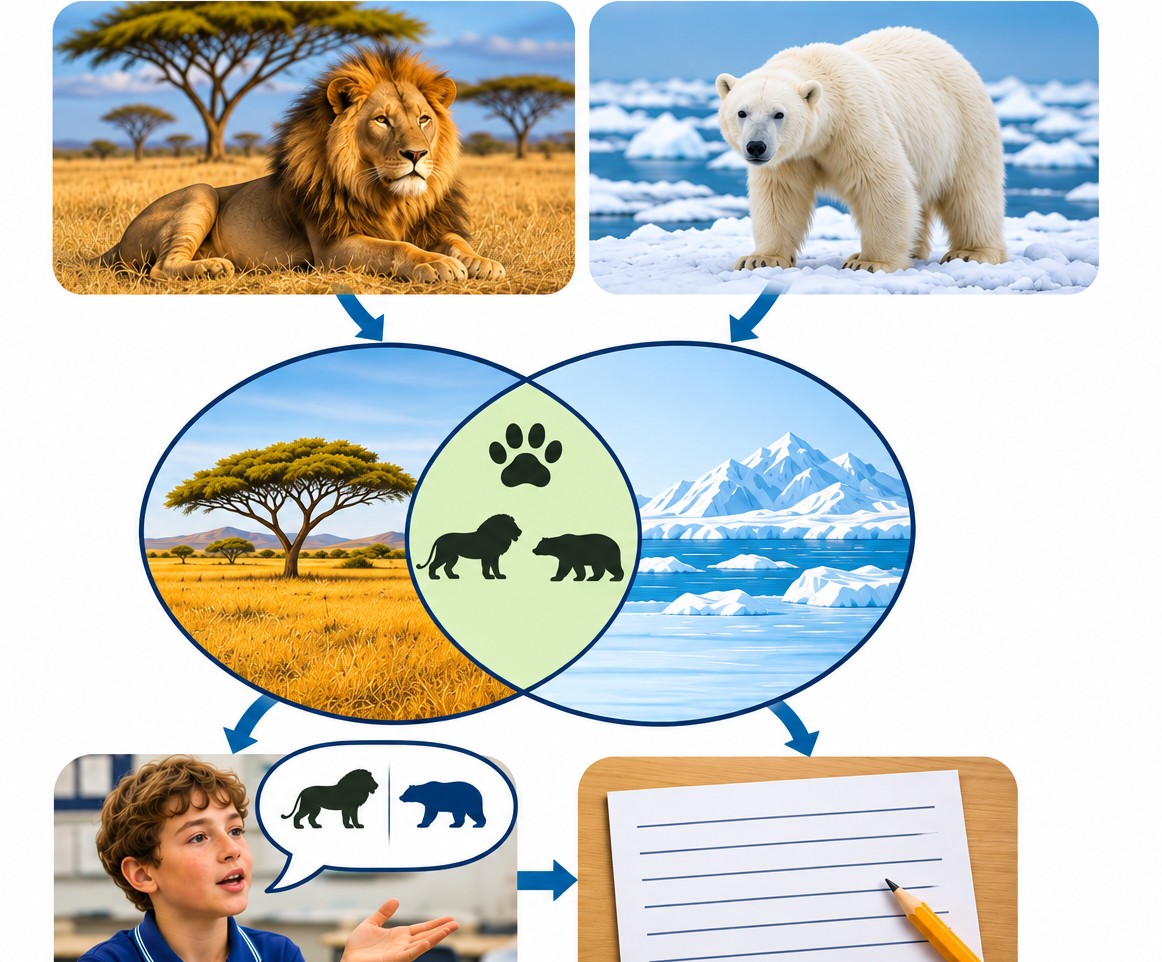
Graphic organisers provide a powerful visual scaffold that helps students move from simply identifying and organising information, to explaining their ideas orally, and finally expressing them in writing.
This oral-to-written progression is particularly helpful for students who have great ideas but struggle to organise them into coherent written explanations.
How Graphic Organisers Support Oral Language and Reading Comprehension -
What Does the Research Tell Us?
Research supports explicit instruction in reading comprehension strategies, including the use of graphic and semantic organisers.
The Education Endowment Foundation identifies graphic organisers as one component of effective comprehension strategy instruction, particularly when students are taught how to apply strategies independently.
Importantly, the evidence relates to broader instructional approaches. It does not demonstrate that completing graphic organisers alone will reliably improve comprehension.
Effective implementation involves selecting appropriate texts, explaining the purpose of the organiser, modelling its use and gradually reducing support.
Graphic organisers are therefore best understood as instructional tools that support purposeful teaching, rather than standalone interventions.
How Graphic Organisers Support Oral Language and Reading Comprehension - Practical Classroom Tips
Teaching Students to Use Graphic Organisers
Teachers and education support staff can introduce graphic organisers through a simple, step-by-step approach. The following example shows how a comparison organiser can help students understand and explain the similarities and differences between a lion and a polar bear using our previous example.
Explain: Introduce the comparison organiser and explain its purpose. For example, “We are going to compare a lion and a polar bear. This organiser will help us see what they have in common and how they are different.”
Show how: Read a short passage about lions and polar bears. Think aloud as you identify important information. For example, “Both animals are predators, which means they hunt other animals for food. That is something they have in common, so I'll put it in the middle of our organiser.”
Practise together: Help students add more information to the organiser. Ask questions such as, “Where does a lion live?” and “How is that different from where a polar bear lives?” Record the answers in the appropriate sections.
Talk about it: Use the completed organiser to help students explain their ideas in full sentences. Model an example: “Both lions and polar bears are predators, but lions live in warm grasslands while polar bears live in the cold Arctic.” Encourage students to practise their own explanations using the organiser as a visual prompt.
Write about it: Ask students to turn their spoken explanations into written sentences. For example, they might write two sentences describing similarities and differences, then combine these into a short comparative paragraph.
Try it independently: Introduce another pair of familiar animals, such as a dolphin and a shark. Encourage students to identify similarities and differences, complete an organiser and explain their ideas with less adult support.
Begin with short, accessible texts and familiar topics. As students become more confident, gradually introduce more complex information and reduce prompts as needed.
Explore Six Free Graphic Organiser Resources
Cause and Effect
Help students understand why events happen and what happens as a result.
View teaching resources
Sequence and Procedure
Teach students to organise events and processes in a meaningful order.
View teaching resourcesCompare and Contrast
Identify similarities and differences between subjects.
View teaching resourcesProblem and Solution
Identify problems, possible solutions and outcomes.
View teaching resourcesDescription
Organise information about topics, features and supporting details.
View teaching resourcesListing and Examples
Group related information and identify relevant examples.
View teaching resourcesReferences and Further Reading
Education Endowment Foundation. Reading Comprehension Strategies. Teaching and Learning Toolkit.
Institute of Education Sciences. (2008). Improving Adolescent Literacy: Effective Classroom and Intervention Practices. What Works Clearinghouse.
Evidence for Learning. Reading Comprehension Strategies. Australian Teaching and Learning Toolkit.
Illustrations on this webpage have been created using an extensive, iterative process on OpenAI's ChatGPT. Creative direction, editing and selection of final images was performed by SpeechLanguage-Resources
