Sequence and Procedure Graphic Organisers for Classroom Use
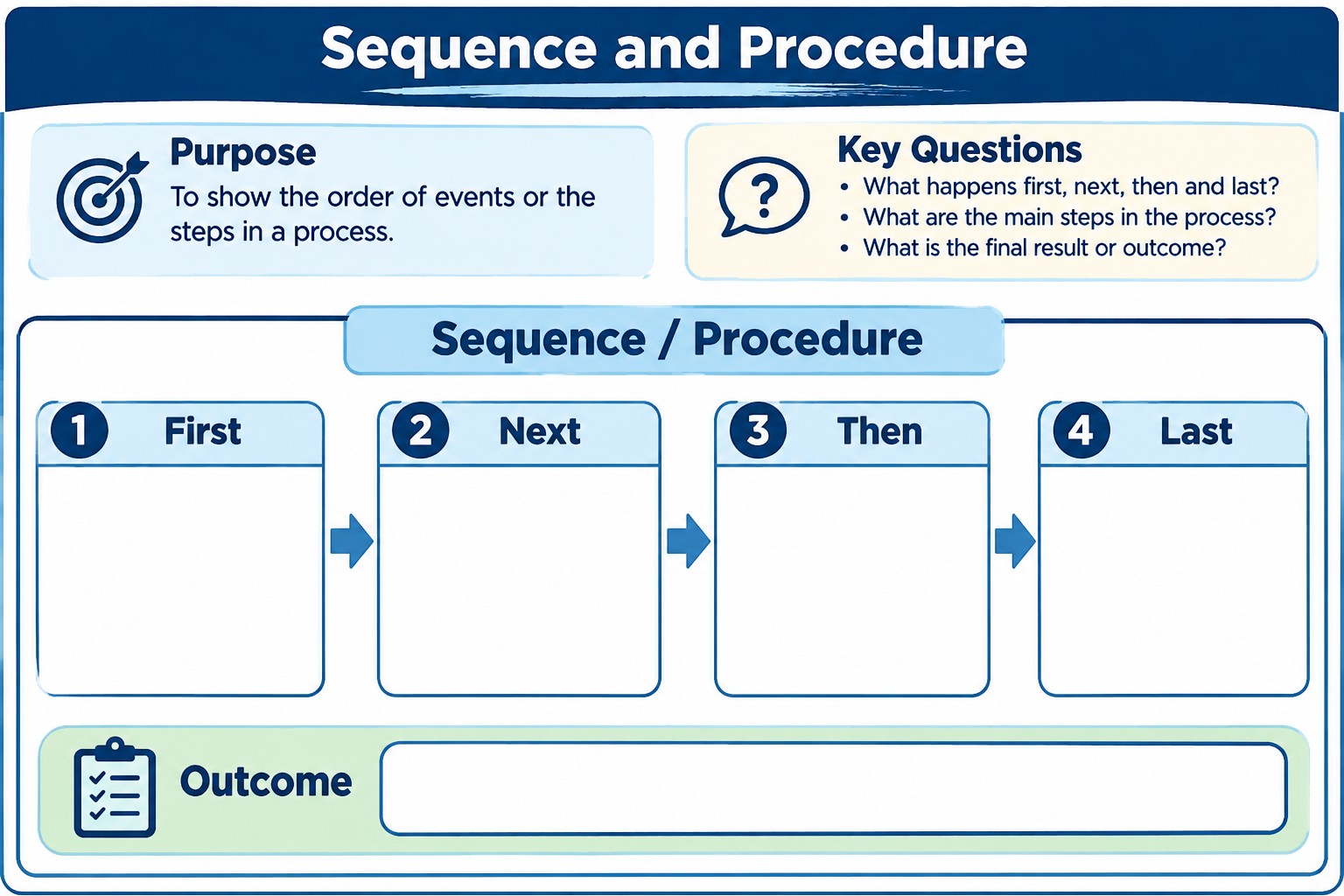
Sequence and Procedure Graphic Organisers for Classroom Use -Help Students Understand and Explain the Order of Events
Sequence and procedure graphic organisers help students identify, organise and explain information in a logical order. They provide a visual structure that supports reading comprehension, oral language and written expression.
These organisers are particularly useful for students who experience difficulties remembering information and understanding relationships between events.
Sequence describes the order in which events occur or stages unfold.
Procedure describes the steps required to complete a task or achieve a particular outcome.
Although both involve order, they serve different purposes. Understanding this distinction can help students interpret texts and communicate information in a more effective manner.
Why Are Sequence and Procedure Graphic Organisers Useful?
Students will come across sequencing information in several curriculum areas. Historical accounts will describe events in chronological order, science texts explain natural processes, and mathematical texts provide sequence of key information to complete and solve problems.
Understanding these types of academic texts requires more than just remembering individual facts. To truly comprehend complex texts such as these, students will need to learn to recognise how one event or step relates to another.
Graphic organisers support this learning by making the structure of information more visible and comprehensible.
Sequence and Procedure Graphic Organisers can help students to...
- Identify important events or steps.
- Organise information in a logical sequence.
- Recall information from spoken and written texts.
- Explain processes using appropriate vocabulary.
- Construct connected sentences and paragraphs.
For students with oral language difficulties, the organiser also provides a visual reference that reduces the need to hold multiple pieces of information in working memory while speaking or writing.
Sequence and Procedure Graphic Organisers for Classroom Use - The Water Cycle Example
Explain the Purpose
Introduce the organiser and explain that it helps us to understand what happens first, what happens next and how events or steps are connected.
Read and Model
Read a short curriculum-based passage aloud. Demonstrate how to identify important information and place it in the correct order.
Use think-aloud statements to make the reasoning explicit.
“The passage tells us that water evaporates before clouds form. I'll place evaporation before condensation on our organiser.”
Practise Together
Invite students to identify additional events or stages. Discuss where each belongs and ask students to explain their choices.
Model accurate responses when necessary.
Explain Orally
Use the completed organiser to model connected explanations. Introduce temporal language such as first, next, after, before, when and finally.
Write an Explanation
Demonstrate how information from the organiser can be converted into complete sentences.
Apply to New Texts
Gradually reduce prompting as needed.
Worked Example: Understanding the Water Cycle
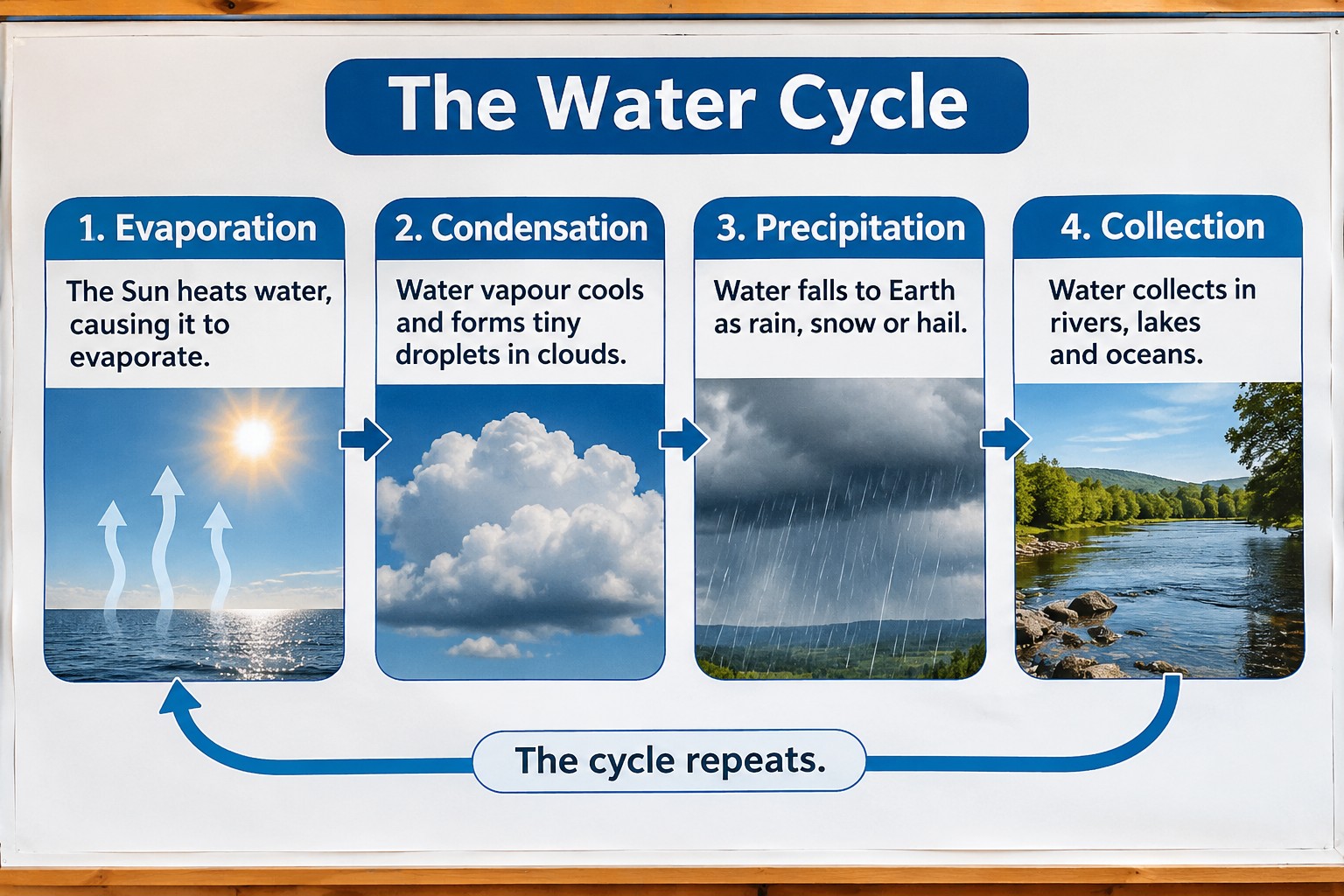
The water cycle provides a visual example of how students can organise and explain a sequence of natural processes.
Begin by reading a short passage describing evaporation, condensation, precipitation and collection.
Ask students to identify the important stages and record them on the organiser.
Completed Sequence Graphic Organiser
- Evaporation: The Sun heats water, causing it to evaporate.
- Condensation: Water vapour cools and forms tiny droplets in clouds.
- Precipitation: Water falls to Earth as rain, snow or hail.
- Collection: Water collects in rivers, lakes and oceans.
Explain that the water cycle is continuous. The final stage connects back to the beginning rather than representing a permanent ending.
Use the completed organiser to support oral explanations.
For example:
“After water evaporates, the water vapour cools and condenses into tiny droplets.”
Students can then practise explaining the complete cycle using the visual prompts.
Sequence and Procedure Graphic Organisers for Classroom Use - How Procedure is Different
How is Procedure Different from Sequence?
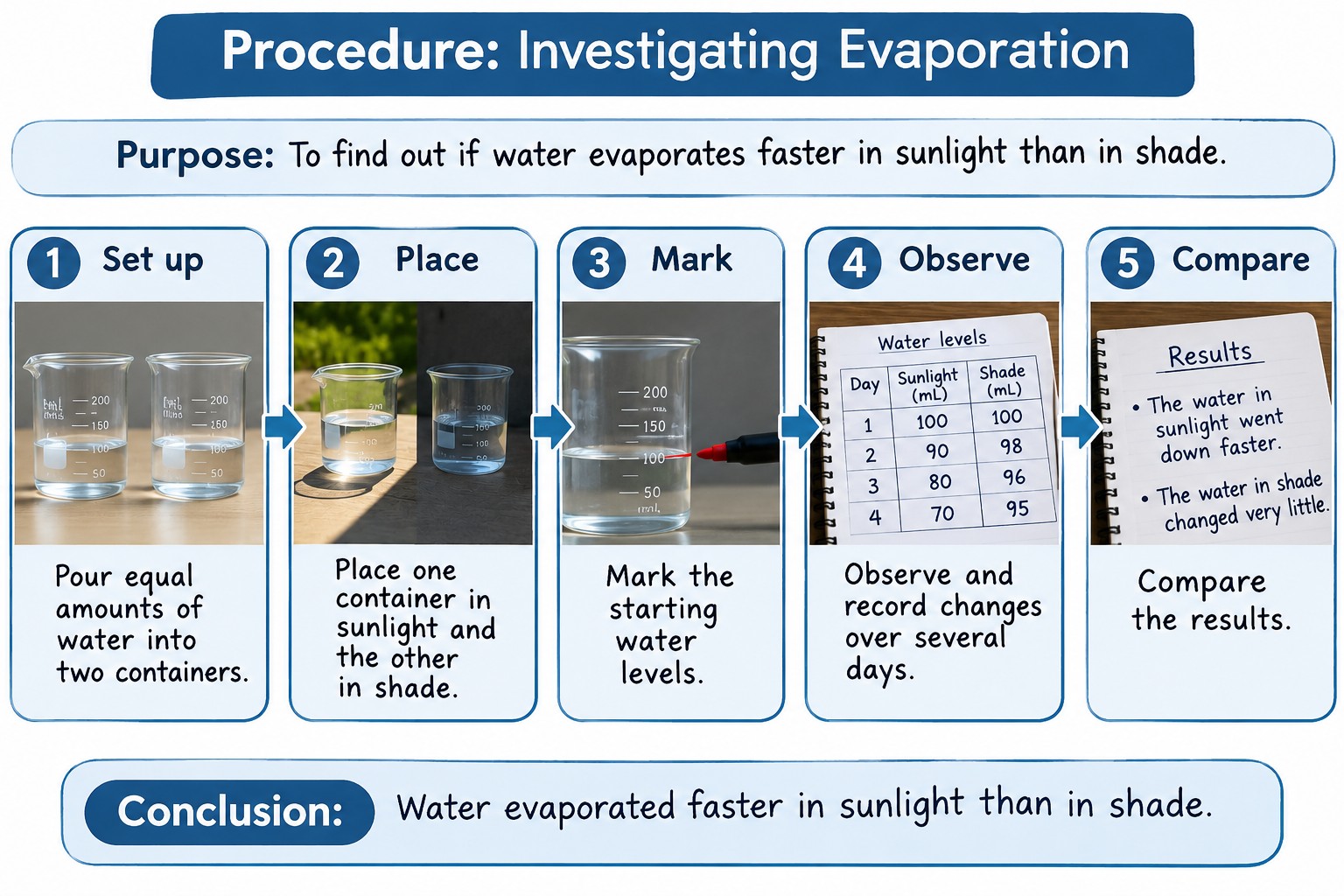
A procedure provides instructions for completing a task.
For example, students investigating evaporation might follow these steps:
- Pour equal amounts of water into two containers.
- Place one container in sunlight and the other in shade.
- Mark the starting water levels.
- Observe and record changes over several days.
- Compare the results.
Unlike the water cycle, this procedure has a defined starting point, an ordered set of actions and a particular purpose.
Moving from Oral Language to Written Expression
Graphic organisers can provide an effective bridge between oral explanations and written paragraphs.
Begin by asking students to describe each stage using a complete sentence.
Next, model how temporal connectives establish relationships between ideas.
For example:
“When the Sun heats water, some of it evaporates into the atmosphere.”
“After the water vapour cools, it condenses into tiny droplets.”
Encourage accurate vocabulary and meaningful connections.
Supporting Students Towards Independence
High Support
Provide a partially completed organiser. Read the passage aloud, identify important information together and model oral sentences.
Moderate Support
Ask students to identify and order information with occasional prompts. Encourage them to explain the sequence orally.
Independent
Students complete the organiser, explain the relationships between stages and write a coherent paragraph using appropriate vocabulary and previously taught connectives.
Downloadable Sequence and Procedure Teaching Resources
The accompanying teaching pack includes:
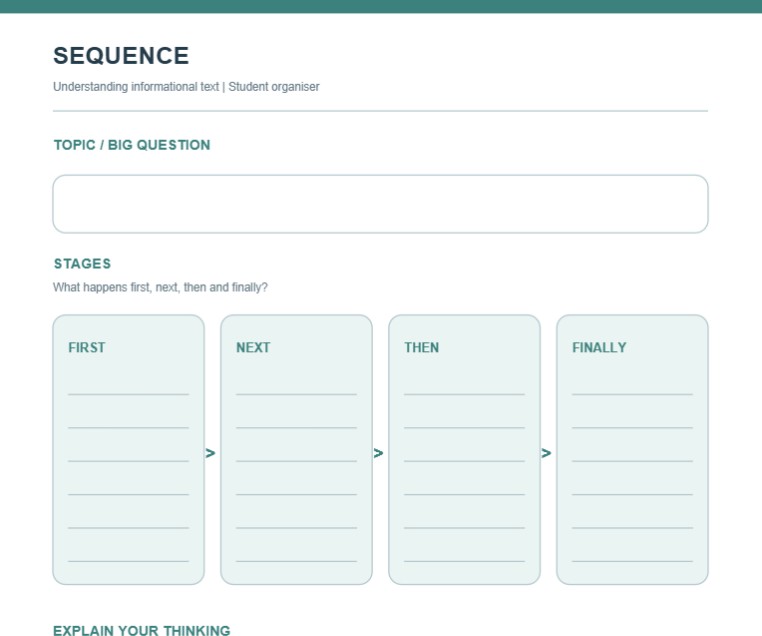
- Blank sequence and procedure graphic organisers.
- A completed water-cycle sequence organiser.
- A six-step instructional guide for teachers and education support staff.
- Student sentence-writing activities and a completed teacher example.
These resources can be used during whole-class instruction, small-group teaching or targeted oral language and literacy intervention.
Click on Image Below to Download the Teaching Pack.
Help Students Become More Independent Learners
Sequence and procedure graphic organisers help students organise information, explain relationships and communicate ideas clearly.
When combined with explicit modelling, the graphic organisers featured on this page provide practical support for developing both your students oral and reading comprehension while giving written expression a real boost.
Sequence and Procedure Graphic Organisers for Classroom Use - Frequently Asked Questions
1. What is the difference between a sequence and a procedure graphic organiser?
A sequence graphic organiser shows the order in which events occur or processes unfold. For example, students might organise the four stages of the water cycle: evaporation, condensation, precipitation and collection.
A procedure graphic organiser shows the steps required to complete a particular task, such as conducting a science experiment.
2. How do sequence graphic organisers improve reading comprehension?
Sequence graphic organisers help students identify important events, recognise their order and understand how information connects across a text.
By organising information visually, students can focus on essential details rather than trying to remember everything they have read.
3. How can teachers use sequence graphic organisers to develop oral language?
Teachers can use sequence organisers to support structured oral explanations.
Teachers can model accurate sentences, expand incomplete responses and gradually reduce prompting as students become more confident explaining events independently.
4. How can sequence graphic organisers support students with language difficulties?
Teachers can reduce language demands by presenting fewer stages, supplying key vocabulary, modelling explanations and allowing students to rehearse responses before writing.
5. How can teachers use sequence graphic organisers to improve students' writing?
Sequence organisers help students plan their ideas before constructing sentences and paragraphs.
Teachers can demonstrate how information recorded in an organiser becomes a series of connected sentences using temporal connectives such as before, after, subsequently and finally.
Students can then combine these sentences into a coherent explanation, gradually moving from supported writing to independent paragraph construction.
6. When should teachers use sequence and procedure graphic organisers?
Sequence organisers are particularly useful when students need to understand or explain events and processes in chronological order.
Procedure organisers are more appropriate when students must follow, explain or write instructions for completing a task.
Illustrations on this webpage have been created using an extensive, iterative process on OpenAI's ChatGPT. Creative direction, editing and selection of final images was performed by SpeechLanguage-Resources
