How to Use Sequence Organisers to Improve Language Skills
How to Use Sequence Organisers to Improve Language Skills
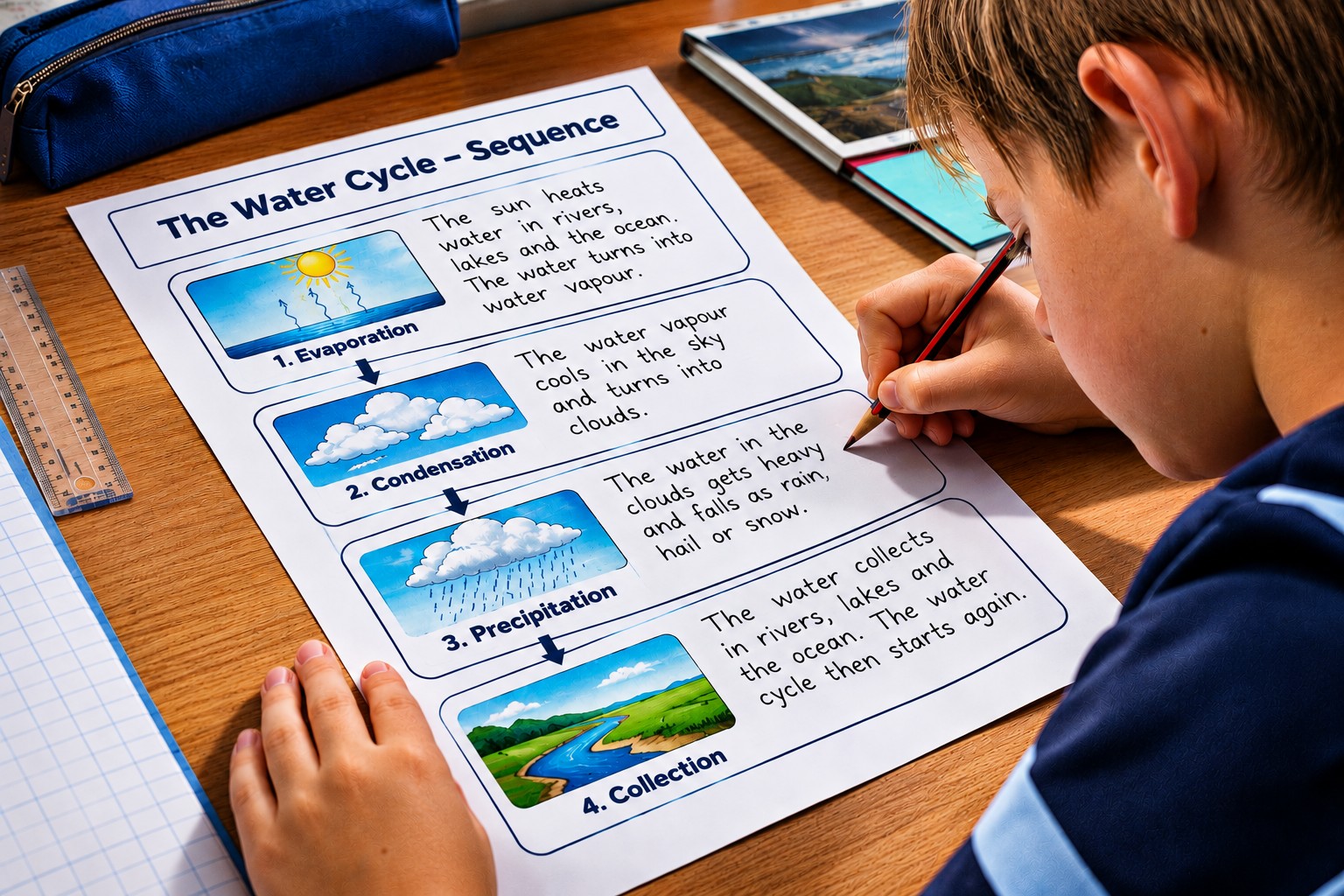
Sequence organisers can help students to understand and explain information in a clear order. Although used mainly for reading comprehension and writing, graphic organisers can be valuable tools for developing students' oral language skills.
Students with language difficulties may understand particular events but could then struggle to explain or articulate how the events connect. This might look like omitting details, confusing the order of events or writing only phrases instead of complete and grammatically correct sentences.
For example, a student learning about the water cycle may understand the individual stages of evaporation, condensation and precipitation but struggle to explain how they are connected.
When asked to describe the water cycle, the student might respond:
“The water goes up. Clouds. Then it rains.”
Although the student may show some understanding of the process, the explanation lacks the precise vocabulary and connections needed.
By using a sequence graphic organiser, the student is prompted to produce a sequenced explanation:
“First, the sun heats the water, causing it to evaporate. Next, the water vapour rises and cools, which makes clouds. When the water droplets become big, they fall back to the ground as rain. Finally, the water collects in rivers and oceans.”
Why Is Sequencing Important for Oral Language?
Successful sequencing requires students to identify important information and then organise it in a logical and clear way.
Graphic organisers make these relationships visible, reducing working-memory demands while students construct spoken explanations.
How to Use Sequence Organisers to Improve Language Skills - Teach Vocabulary
Teach Essential Vocabulary
Students need to understand important vocabulary before explaining a process.
For the water cycle, introduce:
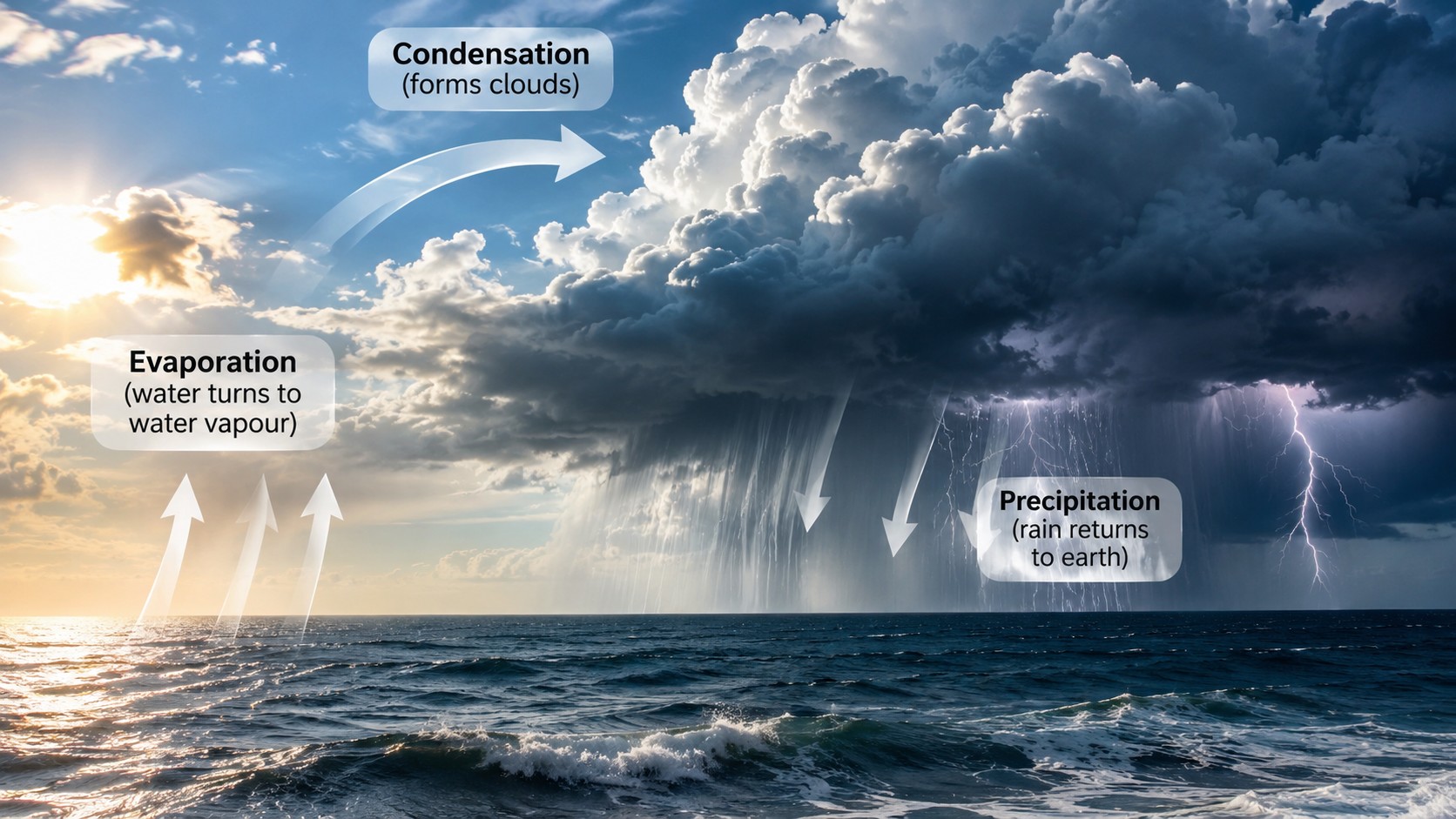
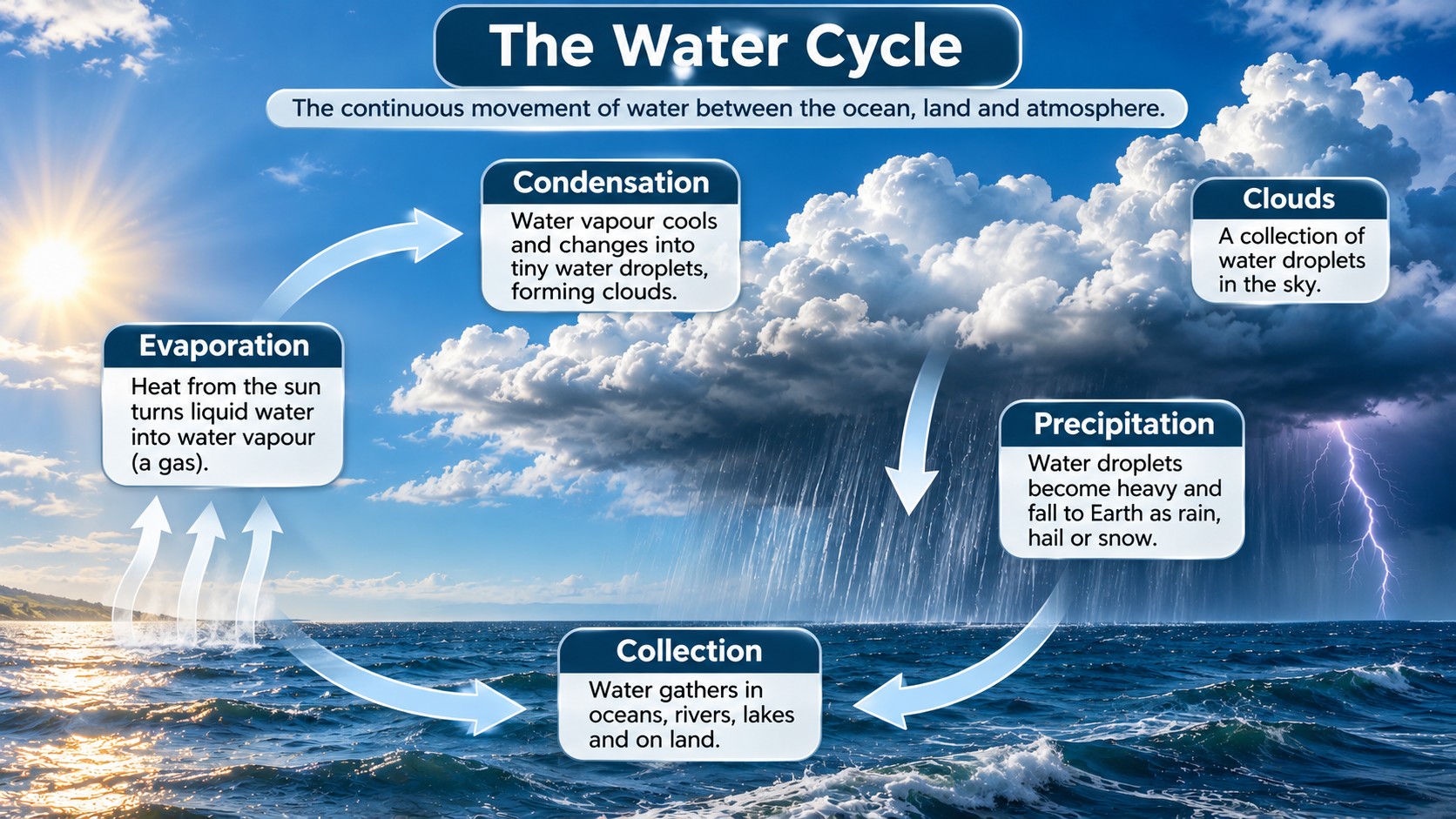
- Evaporation: Liquid water changes into water vapour.
- Condensation: Water vapour cools and forms liquid droplets.
- Precipitation: Water falls as rain, snow or hail.
- Collection: Water gathers in rivers, lakes and oceans.
Connect each word to its corresponding stage.
Rather than simply repeating definitions, ask students to use vocabulary in meaningful sentences.
“Condensation happens when water vapour cools and forms tiny droplets.”
Revisit these words throughout the lesson to strengthen understanding and retrieval.
Provide Structured Oral Rehearsal
Oral rehearsal allows students to practise expressing ideas before writing.
Begin with a completed organiser and ask students to explain one stage at a time.
Provide sentence stems where necessary:
- First, the Sun heats...
- Next, the water vapour...
- Then, water falls...
- Finally, the water collects...
Use a gradual progression:
Allow sufficient thinking time and provide opportunities for partner rehearsal.
Gradually remove sentence stems as students become more confident.
Expand and Recast Student Responses
Students may communicate accurate ideas using incomplete sentences.
Teachers can model more sophisticated language through expansions and recasts.
Student: “Water goes up.”
Teacher expansion: “Yes, the Sun heats the water, causing it to evaporate into the air.”
Student: “Clouds make when water cool.”
Teacher recast: “Clouds form when water vapour cools and changes into tiny droplets.”
These responses preserve the student's meaning while modelling accurate vocabulary and grammar.
Invite students to rehearse selected improved sentences without correcting every response.
Teach Connectives That Explain Relationships
Temporal connectives such as first, next, then, after and finally help students explain order.
However, students should also understand relationships between events.
Basic: “First, water evaporates. Next, clouds form.”
Expanded: “After water evaporates, the water vapour rises and cools, forming tiny droplets.”
Introduce connectives such as when, before, because and so to develop more detailed explanations.
Explain that after indicates when something happens, while because explains why.
Differentiate Support According to Student Needs
High Support
Provide a completed organiser containing three or four stages. Model sentences and ask students to complete supplied stems.
“First, the Sun heats the water and it...”
Expand responses and encourage oral rehearsal.
Moderate Support
Provide an organiser containing key words rather than complete sentences.
Ask students to explain each stage using their own words, including a connective and one additional detail.
Independent
Provide a blank organiser and short informational passage.
Students identify important stages, organise information and explain the complete process using accurate vocabulary and connected sentences.
Gradually reduce prompting as independence develops.
How to Use Sequence Organisers to Improve Language Skills - Written Expression
From Oral Language to Written Expression
Once students can explain a sequence orally, use the same organiser to support writing.
Model how spoken explanations become connected sentences and paragraphs.
For example:
First, the Sun heats water, causing it to evaporate. Next, water vapour cools and forms droplets in clouds. Then, precipitation falls to Earth. Finally, water collects in rivers, lakes and oceans, and the cycle continues.
This approach connects oral language development with written expression.
Key Teaching Message
Sequence graphic organisers are most effective when combined with explicit language instruction.
Teachers should model explanations, teach vocabulary, provide oral rehearsal and expand student responses.
Gradually reducing support helps students become more independent in organising and communicating information, both orally and in writing.
References and Further Reading
Marzano, Robert J., Pickering, Debra J., & Pollock, Jane E. (2001). Classroom Instruction That Works: Research-Based Strategies for Increasing Student Achievement. Association for Supervision and Curriculum Development (ASCD), Alexandria, Virginia, USA.
Rosenshine, Barak (2012). Principles of Instruction: Research-Based Strategies That All Teachers Should Know. American Educator, 36(1), 12–19, 39. American Federation of Teachers, Washington, DC, USA.
Sweller, John, van Merriënboer, Jeroen J. G., & Paas, Fred (2019). Cognitive Architecture and Instructional Design: 20 Years Later. Educational Psychology Review, 31(2), 261–292. Springer Nature.
Illustrations on this webpage have been created using an extensive, iterative process on OpenAI's ChatGPT. Creative direction, editing and selection of final images was performed by SpeechLanguage-Resources
