How to Teach Cause and Effect
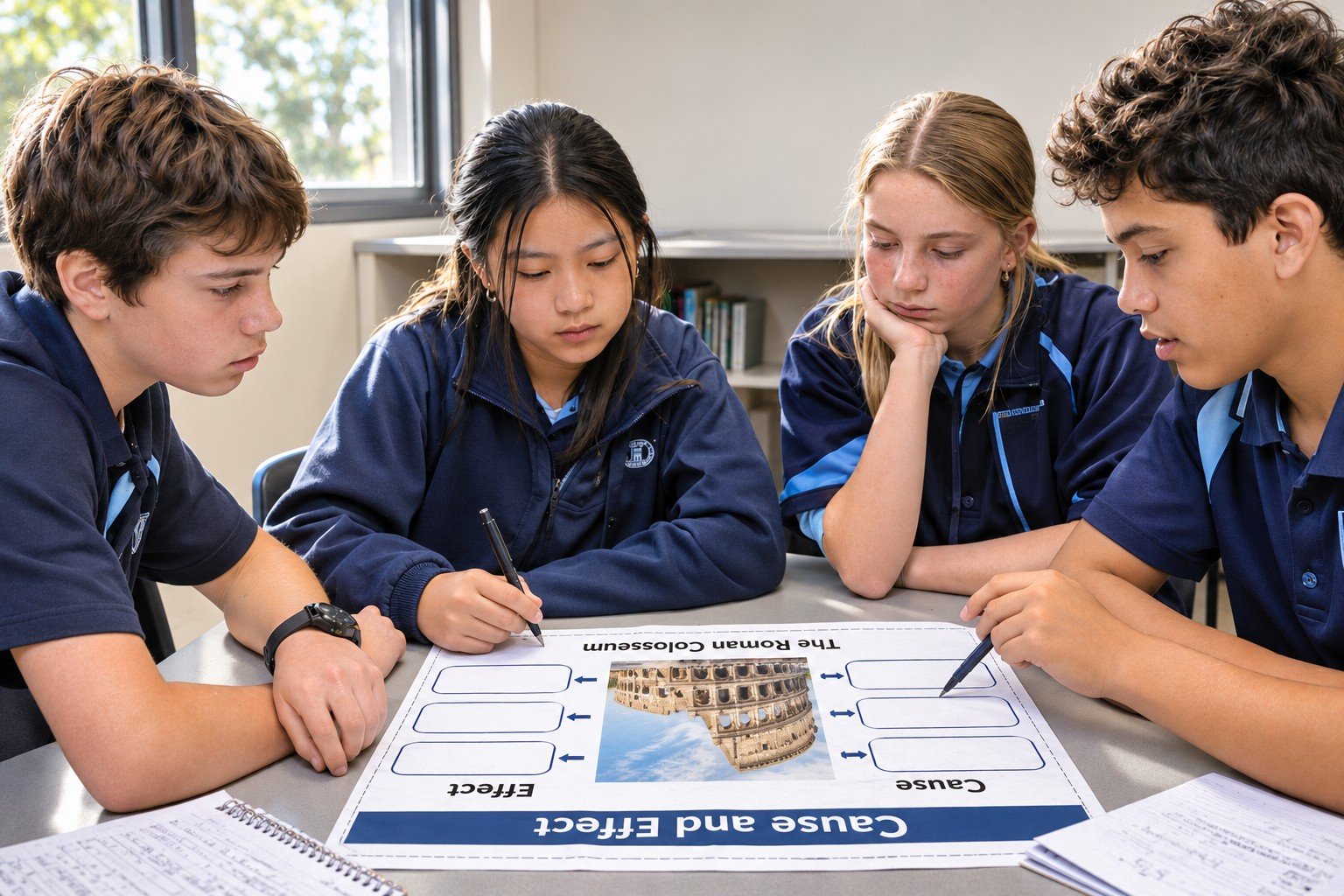
How to Model Cause and Effect in Informational Texts
Select a short passage with an identifiable causal relationship.
For example:
Ancient Roman leaders wanted to entertain citizens and demonstrate Rome's power. Emperor Vespasian began building the Colosseum, an enormous amphitheatre where thousands of spectators could watch public events.
Read the passage aloud and model your thinking:
"The Romans wanted to entertain citizens. That helps explain why they built the Colosseum. I'll record this as our first cause."
Record the information on a graphic organiser while at the same time explaining your reasoning.
This think-aloud approach demonstrates how readers identify and organise important information.
Teach Students to Recognise Causal Language
Informational texts often contain words that signal causal relationships.
- Because: introduces a reason.
- So: introduces a result.
- As a result: signals a consequence.
- Due to: introduces a cause.
- Therefore: introduces a conclusion or result.
Highlight these expressions and discuss how they work to connect ideas in an efficient way.
Explain to students that causal relationships are not always directly stated. We sometimes need to infer how events are connected using information from the text and background knowledge.
Use Graphic Organisers to Identify Multiple Causes
Introduce texts where several factors contribute to an outcome.
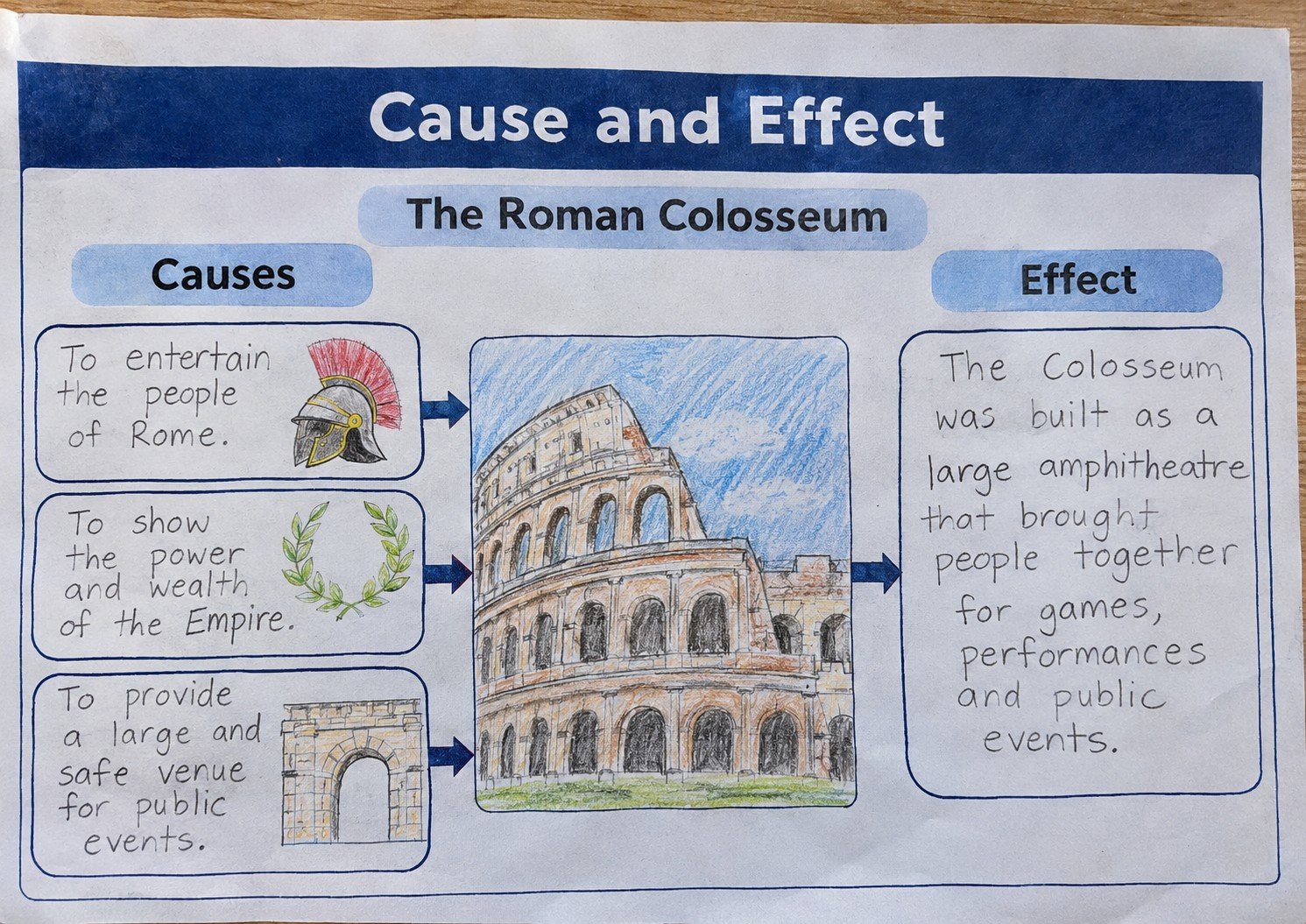
For example, Roman leaders had several reasons for building the Colosseum:
- Providing public entertainment.
- Demonstrating Rome's wealth and power.
- Gaining support from Roman citizens.
Record these causes separately before connecting them to the main effect: the construction of the Colosseum.
Prompt students with...
- What happened?
- Why did it happen?
- Which are the most important details that explain the outcome?
- Did several factors contribute to the construction?
Respond When Students Confuse Causes and Effects
Some students identify relevant information quite well but may struggle to work out whether the event represents either a cause or an effect.
For example:
Teacher: "Why did the Romans build the Colosseum?"
Student: "Because they built a big stadium."
Teacher: "You've told me what the Roman leaders built. We need to explain why the Romans built such a thing. What did Roman leaders want their citizens to do there?"
Student: "Watch gladiators."
Teacher: "Sure, yes. The did want to entertain people. Let's explore that reason using the word because."
Student: "The Romans built the Colosseum because they wanted to entertain people."
This interaction demonstrates how guided questioning, modelling and reformulation can help students distinguish an outcome from its contributing causes.
Move From Oral Explanations to Writing
A completed organiser provides the starting point for constructing an explanation.
Model a sentence:
"The Romans built the Colosseum because their leaders wanted to entertain citizens, demonstrate Rome's power and gain public support."
Ask students to rehearse their explanations orally before writing.
Provide sentence starters when necessary and use expansions or recasts to develop more complete responses.
Gradually encourage students to construct explanations independently using because, so and as a result.
Check Student Understanding and Gradually Reduce Support
Provide a short, unfamiliar passage and ask students to:
- Identify the main effect.
- Identify contributing causes.
- Explain the relationship in a complete sentence.
Record whether students respond independently or require prompting.
Gradually remove sentence starters, partially completed organisers and other scaffolds as students demonstrate increasing accuracy.Supporting Students With Language Difficulties
Students with language difficulties may require explicit vocabulary instruction, shorter passages, additional processing time and opportunities for oral rehearsal.
Maintain the learning objective while adjusting the language demands and level of adult support.
Key Teaching Principle
Graphic organisers prove to be most valuable when students are guided to use them to explain relationships.
Teachers are encouraged to use explicit modelling, discussion and guided practice with the added support of graphic organizers to help their students develop the language and thinking needed to understand informational texts.
Free Classroom Resources
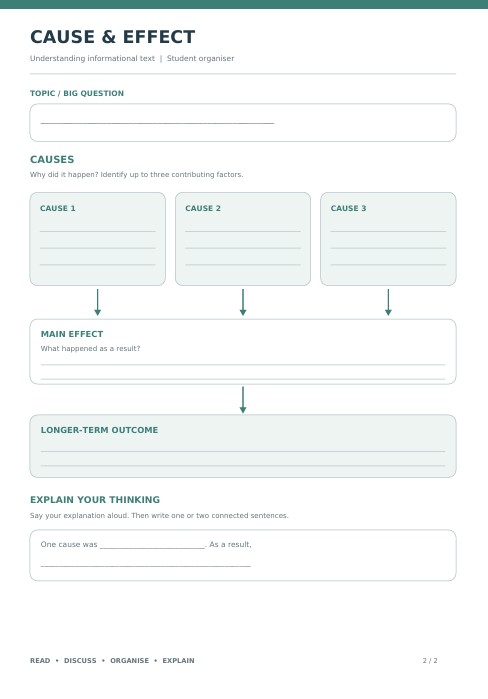
Download our free Cause and Effect Graphic Organisers and Teaching Action Guide for practical classroom activities, worked examples and instructional guidance.
Illustrations on this webpage have been created using an extensive, iterative process on OpenAI's ChatGPT. Creative direction, editing and selection of final images was performed by SpeechLanguage-Resources
