How Teachers Can Use Graphic Organisers to Support Student Learning
How Teachers Can Use Graphic Organisers to Support Student Learning
Students with oral language difficulties may struggle to understand classroom instructions, learn new vocabulary, organise their thoughts or express ideas in complete sentences. These difficulties can affect reading comprehension, written expression and participation in classroom discussions.
Teachers can support these students by making spoken language more accessible while explicitly teaching the vocabulary and sentence structures needed for successful learning.
The goal is for students to understand and eventually use increasingly complex language independently.
Reduce Language Complexity
Students with oral language difficulties may find it challenging to process lengthy explanations, unfamiliar vocabulary or instructions containing several steps.
Teachers can make classroom language more accessible by:
- Using short, clearly structured sentences when introducing new information.
- Presenting instructions in manageable steps.
- Emphasising important words and concepts.
- Checking understanding before students begin independent work.
- Repeating or rephrasing information when necessary.
For example, rather than saying:
"Identify the factors that contributed to the construction of the Colosseum and explain their significance."
A teacher might initially use simpler, more direct language:
"Why did the Romans build the Colosseum? Let's identify three reasons."
Both instructions address the same historical content, but the second reduces the language-processing demands.
Importantly, simplified language should provide an entry point to learning rather than replace exposure to more sophisticated academic language.
Explicitly Teach Important Vocabulary
Vocabulary knowledge is fundamental to oral language comprehension, reading and written expression.
Students with language difficulties often require repeated, explicit opportunities to learn unfamiliar words and use them in meaningful contexts.
Teachers can introduce important vocabulary by:
- Providing a clear, student-friendly definition.
- Explaining the word within a familiar context.
- Provide examples.
- Encouraging students to use the new word in spoken sentences.
- Revisit the word during subsequent lessons many times.
Classroom example
When introducing the word consequence, a teacher might explain:
"A consequence is something that happens as a result of an action or event."
The teacher could then provide an example:
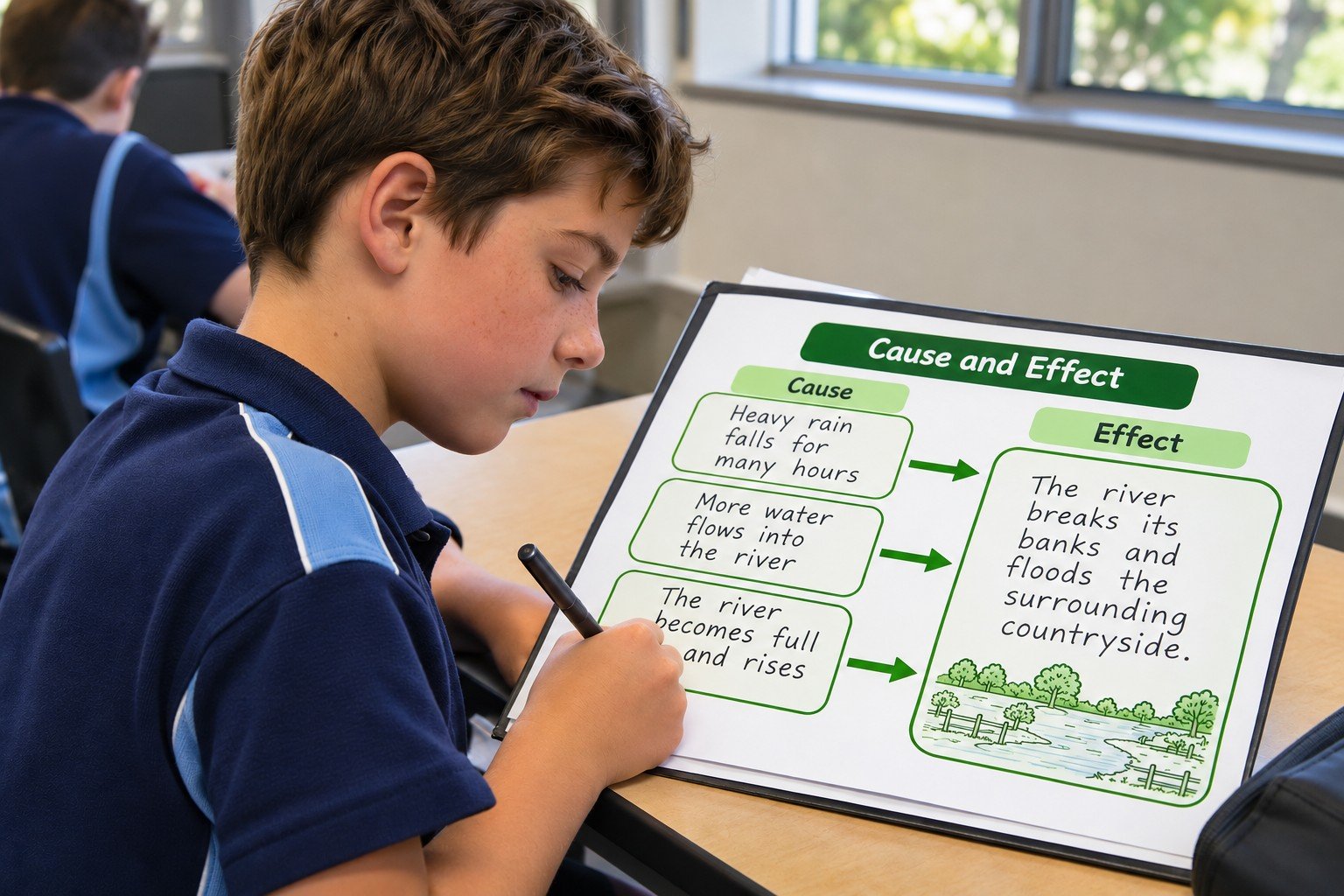
"Heavy rain caused the river to flood. The flooding was a consequence of the heavy rain bursting the river banks and spilling over on to land."
How Teachers Can Use Graphic Organisers to Support Student Learning - Provide Prompts
Model Complete Sentences and Provide Sentence Starters.
Teachers can demonstrate appropriate sentence structures before expecting students to produce them independently.
Sentence starters provide additional support.
For example:
Teacher: "Why did the river flood?"
Student: "Lots of rain."
Teacher: "So the river flooded because..."
Student: "The river flooded because there was lots of rain."
As students become more confident, teachers can gradually remove the sentence starter prompts.
Connectives such as because, but and so are particularly useful because they help students express causal relationships, contrasts and consequences.
Expand and Recast Student Responses
Expansions and recasts allow teachers to model more sophisticated language while maintaining the student's original meaning.
An expansion adds information to a student's response.
Student: "The river floods."
Teacher: "Yes, the rain fell throughout the night and caused the river to break its banks."
A recast reformulates a student's response using more accurate grammar or sentence structure.
Student: "The rain made a flood."
Teacher: "The rain caused the river to flood the surrounding countryside."
Teachers can also invite students to try the improved sentence themselves, providing another opportunity for language practice.
Allow Additional Processing Time
Students with oral language difficulties may require additional time to understand questions, retrieve vocabulary and formulate responses.
Teachers should avoid immediately repeating, rephrasing or answering a question when a student hesitates.
Instead:
Ask a clear question.
Pause to allow the student time to think.
Provide a visual cue or sentence starter if needed.
Acknowledge the response and extend it where appropriate.
Additional processing time is particularly important during inferential questioning, when students must combine information and explain their reasoning.
Gradually Remove Scaffolds as Independence Develops
Effective language support should be responsive to the student's developing skills.
Teachers can use a gradual progression:
High support: Model a complete sentence and invite the student to repeat or complete it using a visual organiser.
Moderate support: Provide a sentence starter and encourage the student to select relevant information independently.
Independent: Ask the student to explain an idea using a complete sentence without a supplied starter.
Students may require different levels of support depending on the familiarity and complexity of the task.
The aim is to gradually transfer responsibility from the teacher to the student while maintaining opportunities for successful participation.
How Teachers Can Use Graphic Organisers to Support Student Learning - Free Oral Language Checklist
Illustrations on this webpage have been created using an extensive, iterative process on OpenAI's ChatGPT. Creative direction, editing and selection of final images was performed by SpeechLanguage-Resources
