How Cause and Effect Graphic Organisers Improve Writing

How Cause and Effect Graphic Organisers Improve Writing.
Cause-and-effect graphic organisers help students move beyond listing facts to explaining why events happen and what happens as a result.
For students who struggle with written expression, organising ideas before writing can reduce the demands on working memory. Rather than simultaneously deciding what to say, how to structure a sentence and how to spell individual words, students can focus on one task at a time.
However, completing a graphic organiser does not automatically improve writing. The greatest instructional benefit comes when teachers explicitly demonstrate how to transform the information in an organiser into meaningful sentences and connected explanations.
Start with a completed graphic organiser
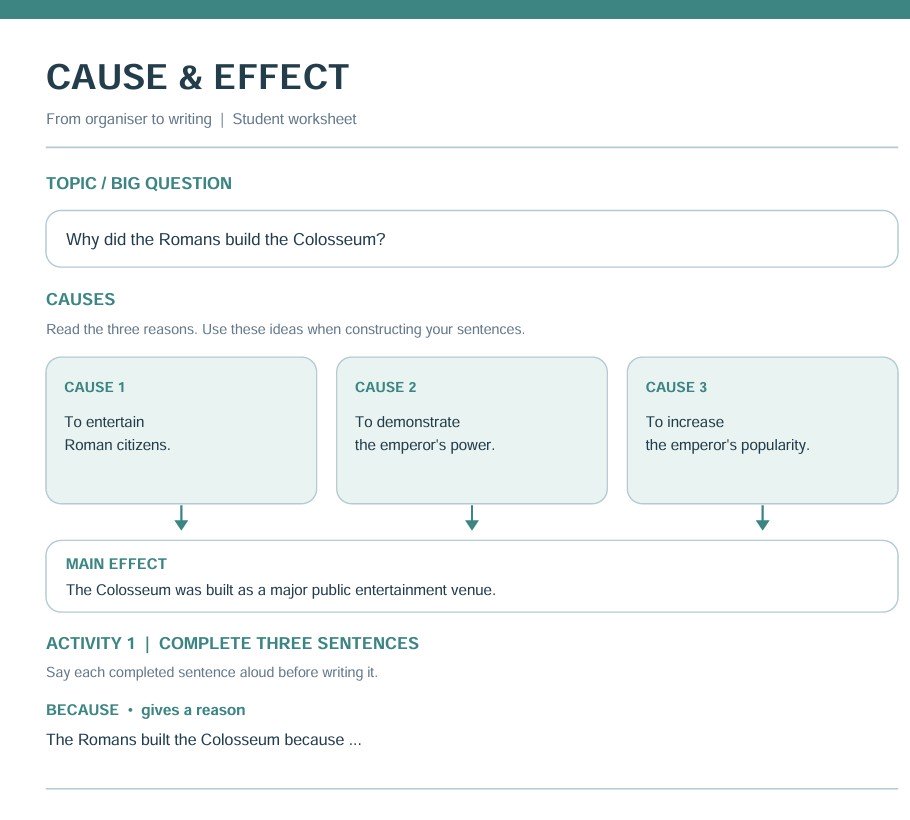
Consider a Year 5 history lesson exploring why the ancient Romans constructed the Colosseum.
Students identify three reasons:
- To provide public entertainment.
- To demonstrate the emperor's power and generosity.
- To increase the emperor's popularity among Roman citizens.
Main effect: The Colosseum was constructed as a major public entertainment venue in ancient Rome.
The organiser provides the ideas students need. The next step is teaching them how to express the relationships between those ideas in writing.
Model sentences using because, but and so
The Writing Revolution approach uses because, but and so to help students develop sentences that express different logical relationships..
Begin with a simple sentence:
The Romans built the Colosseum.
Show students how to expand this idea using three different connectives.
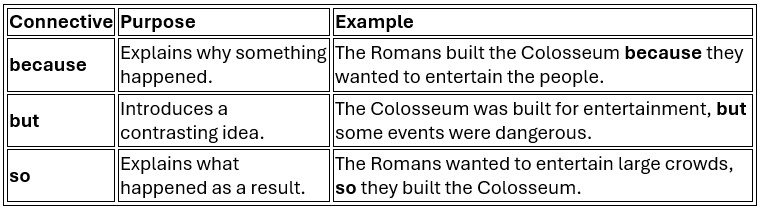
How Cause and Effect Graphic Organisers Improve Writing - Teaching Tip
Teaching tip: Draw students' attention to how each connective changes the meaning of the sentence.
Ask three questions:
Because: Why did the Romans build the Colosseum?
But: What contrasting information can we add?
So: What did the Romans do as a result of wanting to entertain people?
Important: Students do not need to use the same sentence beginning for all three connectives. The goal is to construct meaningful sentences that accurately express reasons, contrasts and results.
This activity helps students move from identifying information in a graphic organiser to explaining relationships between ideas in complete sentences
Rehearse sentences orally before writing
Oral rehearsal is particularly valuable for students with developmental language difficulties or limited working memory.
Use a short, predictable instructional routine:
Teacher models
"The Romans built the Colosseum because they wanted to entertain large crowds."
Students rehearse
Students repeat the sentence or construct a different sentence using the organiser.
Teacher expands
Student: "The emperor wanted his people to be happy."
Teacher: "The emperor wanted to increase his popularity, so he provided public entertainment for the people."
Students try again
Students say their improved sentence before writing it.
This process allows teachers to provide immediate feedback about sentence meaning, vocabulary and grammatical accuracy.
For students requiring additional support, display the connective and provide a partially completed sentence.
Move from individual sentences to connected explanations
Once students can construct accurate sentences, demonstrate how to combine information from the organiser into a short paragraph.
Example paragraph
The Romans built the Colosseum for several reasons. Emperors wanted to entertain large crowds because public spectacles were an important part of Roman life. The Colosseum provided entertainment, but it also demonstrated the wealth and power of the empire. Emperors wanted to gain public support, so they invested in impressive buildings and spectacles.
Students are then prompted to discuss how each sentence contributes to the explanation.
Highlight the opening sentence, supporting reasons and connections between ideas.
Students can then use the same structure to construct their own paragraph.

How Cause and Effect Graphic Organisers Improve Writing - Instructional Support
Move from individual sentences to connected explanations
Once students can construct proper sentences, demonstrate how to combine information outlined in the organiser into a short paragraph.
Example paragraph
The Romans built the Colosseum for several reasons. Emperors wanted to entertain large crowds because public spectacles were an important part of Roman life. The Colosseum provided entertainment, but it also demonstrated the wealth and power of the empire. Emperors wanted to gain public support, so they invested in impressive buildings and spectacles.
Discuss how details in each sentence contributes to the overall construction of the paragraph.
Highlight the opening sentence, supporting reasons and connections between ideas.
Students can then use the same structure to construct their own paragraph.
Provide instructional support as needed
Students will vary in their ability to independently organise information into written language.
High support
Provide students with a partially completed sentence, such as "The Romans built the Colosseum because..."
Prompt students to use information from their graphic organiser to finish the sentence aloud. Model the complete sentence and have students repeat it before writing.
Moderate support
Ask students to select two pieces of information from their completed graphic organiser and use them to construct sentences with because or so.
For example, a student might select the ideas public entertainment and the construction of the Colosseum.
The teacher provides a connective (subordinating conjunction so) and asks the student to construct a sentence:
"The Romans wanted to entertain large crowds, so they built the Colosseum."
Prompt students to say their sentences out loud before writing them. Provide feedback on sentence meaning, grammar and the appropriate use of connectives.
Independent
Ask students to use several pieces of information from their completed graphic organiser to write a short explanatory paragraph.
For example:
"The Romans built the Colosseum for several reasons. They wanted to entertain large crowds because public spectacles were popular in ancient Rome. The Colosseum provided entertainment, but it was also a display of the emperor's power."
Encourage students to include an introductory sentence, explain at least two causes and use appropriate connectives to link their ideas.
Students should independently review their writing to check that their sentences are grammatically complete and that the relationships between causes and effects are clear.
Gradually reduce support as students become more confident. Begin with oral sentence completion, progress to constructing sentences with selected connectives, and eventually encourage students to write connected explanations independently.
Check whether students are improving
Use a brief writing sample before and after a teaching sequence.
Look for improvements in four areas:
- Accuracy: Does the sentence express a correct cause-and-effect relationship?
- Sentence construction: Are ideas expressed in grammatically complete sentences?
- Connectives: Are because, but and so used appropriately?
- Coherence: Does the paragraph explain relationships rather than simply list information?
Download the Cause and Effect Graphic Organiser Teaching Example
Illustrations on this webpage have been created using an extensive, iterative process on OpenAI's ChatGPT. Creative direction, editing and selection of final images was performed by SpeechLanguage-Resources
