Compare and Contrast Graphic Organisers Teach Better Thinking
Compare and Contrast Graphic Organisers Teach Better Thinking
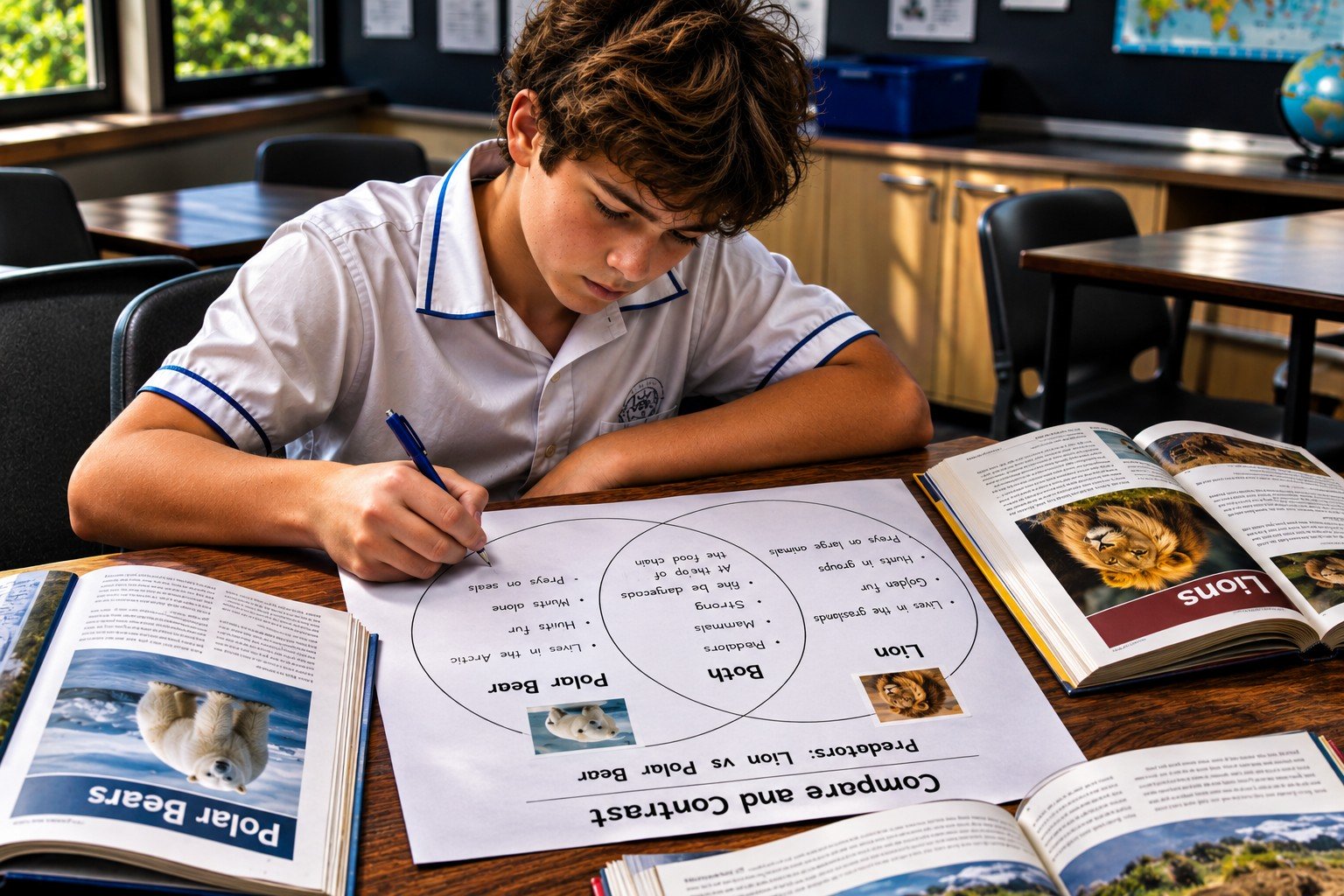
Compare and contrast graphic organisers help students identify and communicate similarities and differences between subjects, concepts and ideas. This type of graphic organiser provides a visual framework that supports both reading comprehension skills and written expression.
Many students can recall individual facts about a particular topic but may experience some difficulty identifying relationships between contrasting pieces of information. Compare and contrast graphic organisers make these relationships more explicit and comprehensible.
When combined with explicit instruction, structured discussion and sentence-writing activities, these organisers become valuable tools for developing thinking and reasoning skills.
Compare and Contrast Graphic Organisers Teach Better Thinking - What is a Compare and Contrast Graphic Organiser?
A compare and contrast graphic organiser is a visual representation of the similarities and differences between two or more subjects.
Two commonly used formats are:
- Venn diagrams: Overlapping circles that represent shared and distinctive characteristics.
- Structured comparison tables: Tables that organise information according to specific features or categories.
Although Venn diagrams are useful for introducing comparison skills, structured comparison tables encourage students to examine equivalent features systematically.
For example, when comparing two animals, students might organise information according to habitat, diet, physical appearance and social behaviour.
This structure helps students move beyond listing unrelated facts towards making meaningful comparisons.Benefits of Compare and Contrast Graphic Organisers
Compare and contrast graphic organisers support several important areas of learning.
- Reading comprehension: Students identify important information and recognise relationships between ideas.
- Vocabulary development: Students develop a deeper understanding of words through classification, categorisation and semantic relationships.
- Oral language: Students practise explaining similarities and differences using increasingly precise vocabulary and complex sentences.
- Written expression: Organised information provides a foundation for constructing sentences and coherent paragraphs.
- Reasoning: Students learn to examine evidence, identify patterns and draw conclusions.
- Working memory support: A visual record of information reduces the need to hold multiple facts in mind simultaneously.
These benefits are particularly relevant for students who experience difficulties with oral language, reading comprehension or written expression.
Compare and Contrast Graphic Organisers Teach Better Thinking - Classroom Example
Consider a Year 3 or Year 4 classroom studying animals and their habitats.
The teacher introduces two short informational texts describing African lions and polar bears. Students read or listen to the texts before identifying important information about each animal.
The teacher then models how to transfer this information into a structured comparison graphic organiser.
| Feature | African lion | Polar bear |
|---|---|---|
| Habitat | African grasslands | Arctic regions |
| Diet | Mainly large land animals | Mainly seals |
| Appearance | Short, tawny fur | Thick, whitish fur |
| Social behaviour | Lives in groups called prides | Usually solitary |
| Classification | Mammal | Mammal |
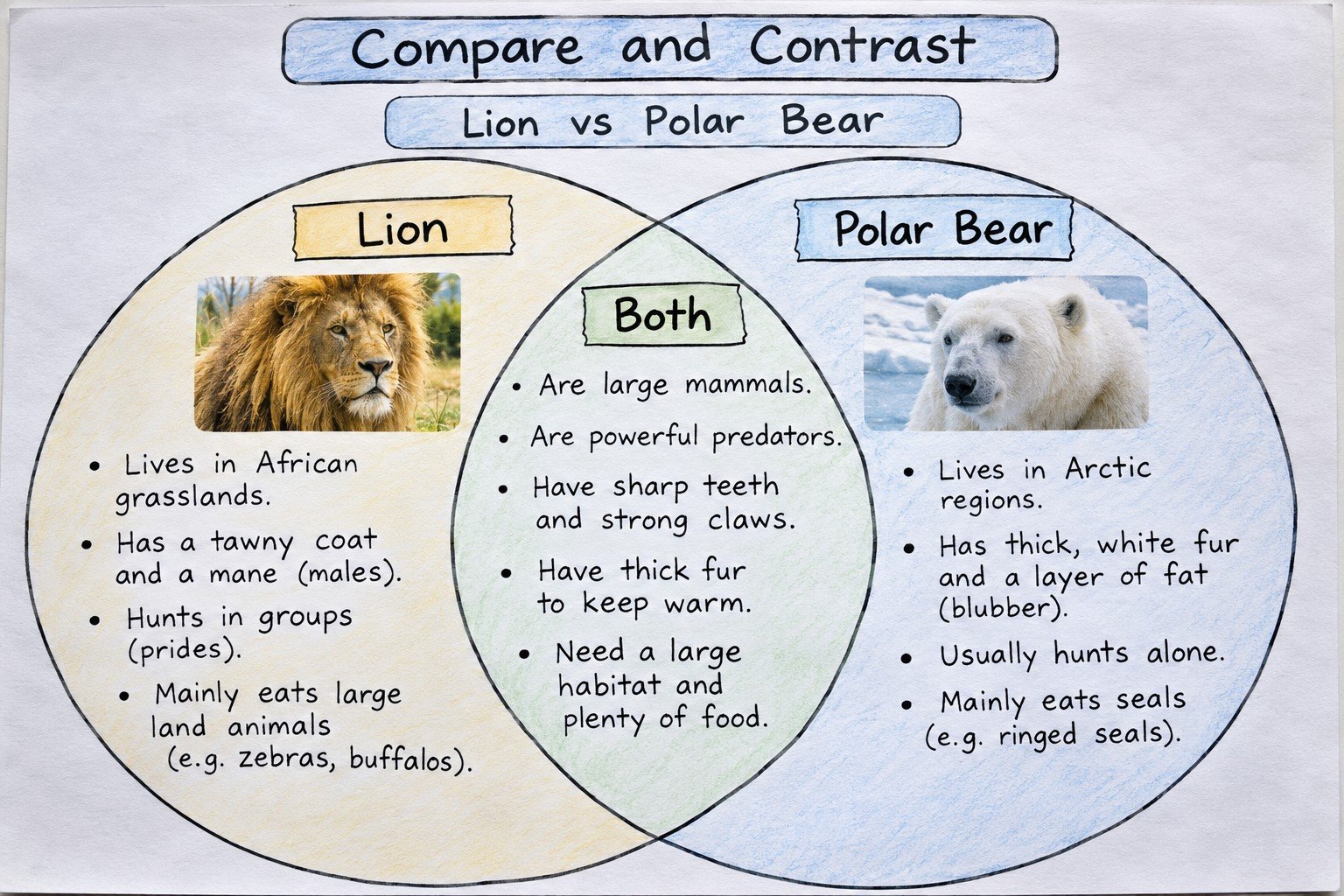
Completed compare and contrast graphic organiser: African lion and polar bear.
The completed organiser provides a visual reference that students can use to answer questions, discuss similarities and differences and construct written explanations.
Compare and Contrast Graphic Organisers Teach Better Thinking - How to Teach Compare and Contrast Skills
Students benefit from explicit instruction in how to use comparison graphic organisers.
The following instructional sequence provides a practical classroom approach.
Explain: Introduce the concepts of similarity and difference. Explain that effective comparisons involve examining the same feature of each subject.
Model: Demonstrate how to identify information about habitat in both texts. Use a think-aloud to explain how this information is recorded in the organiser.
Guide: Work collaboratively with students to identify and record additional features, such as diet and physical appearance.
Discuss: Ask students to explain similarities and differences using complete spoken sentences. Provide prompts, vocabulary support and sentence models where necessary.
Write: Demonstrate how information from the completed organiser can be transformed into connected written sentences.
Apply: Provide opportunities for students to compare new subjects with gradually reduced teacher support.
Developing Oral Language Through Comparison
A completed graphic organiser provides a valuable prompt for structured classroom discussion.
Teachers can encourage students to develop increasingly sophisticated spoken explanations through questions such as:
- How are lions and polar bears similar?
- How are their habitats different?
- How does their fur help them survive in their respective environments?
Teachers can also expand students' responses by modelling more precise vocabulary and sentence structures.
For example, a student might say, “They both eat meat.”
The teacher could expand this response: “Both lions and polar bears are carnivores, which means they primarily eat other animals.”
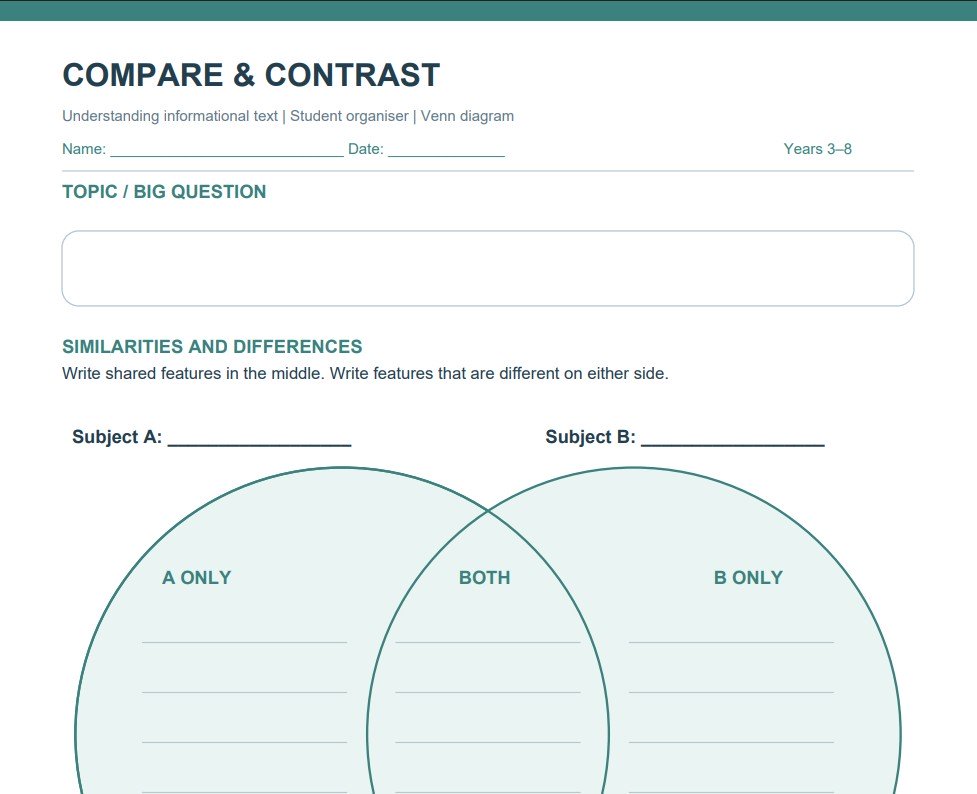
Click on Link Below to Download the Teaching Pack
Compare and Contrast Graphic Organisers Teach Better Thinking - Graphic Organisers for Written Expression
Compare and contrast activities provide opportunities for explicit sentence-level writing instruction, including strategies drawn from The Writing Revolution.
Teachers can introduce sentence stems and connectives that communicate similarities and differences.
Both: Both lions and polar bears are carnivorous mammals.
But: Lions and polar bears are both predators, but they live in different environments.
Whereas: Lions live in warm grasslands, whereas polar bears inhabit cold Arctic regions.
Unlike: Unlike lions, polar bears usually live alone.
Students can then combine these ideas into a short comparison paragraph.
Oral rehearsal before writing can help students formulate sentences and organise their ideas more effectively.
Supporting Students with Language Difficulties
Students with language difficulties may require additional support to identify relevant information and communicate relationships between ideas.
Helpful strategies include:
- Pre-teaching important vocabulary.
- Providing partially completed graphic organisers.
- Limiting the number of comparison categories initially.
- Modelling complete spoken sentences.
- Providing sentence stems and appropriate connectives.
- Allowing additional processing and oral rehearsal time.
Gradually reduce these supports as students demonstrate greater understanding and independence.
The ultimate goal is for students to independently identify meaningful similarities and differences and communicate their understanding through spoken and written language.
1. How do compare and contrast graphic organisers improve students' writing?
Comparison organisers help students select and organise relevant information before writing. Combined with explicit sentence construction instruction, they support the development of coherent comparison paragraphs and more sophisticated written explanations.
2. How can compare and contrast graphic organisers support students with oral language difficulties?
Visual organisers reduce the demands of remembering and organising information. Structured questioning, vocabulary instruction and oral rehearsal help students communicate similarities and differences more clearly.
3. What is the difference between a Venn diagram and a structured comparison table?
Venn diagrams visually represent shared and distinctive characteristics. Structured comparison tables encourage students to examine equivalent features systematically, making them particularly useful for more detailed curriculum-based comparisons.
4. How do you explicitly teach students to identify similarities and differences?
Effective instruction involves teacher modelling, guided questioning, collaborative completion of graphic organisers and independent practice. Begin with familiar, concrete subjects before introducing more abstract concepts.
5. What vocabulary should students learn when comparing and contrasting?
Students benefit from explicit instruction in words and phrases such as both, similarly, whereas, unlike, however and in contrast. These language structures help students communicate relationships between ideas precisely.
6. How do compare and contrast graphic organisers support reading comprehension?
Comparison organisers help students identify key information, recognise relationships between ideas and understand the structure of informational texts. They also provide a framework for summarising information.
7. How can compare and contrast activities develop higher-order thinking skills?
Comparing subjects encourages students to analyse features, categorise information, evaluate evidence and draw conclusions. Effective questioning extends learning beyond simply identifying similarities and differences.
8. How can compare and contrast graphic organisers be used across curriculum areas?
Comparison organisers can support learning in science, history, geography, mathematics and literature. Students can compare animals, historical periods, environments, mathematical concepts and fictional characters.
References
Dexter, D. D., & Hughes, C. A. (2011). Graphic organizers and students with learning disabilities: A meta-analysis. Learning Disability Quarterly, 34(1), 51–72.
Graham, S., & Perin, D. (2007). A meta-analysis of writing instruction for adolescent students. Journal of Educational Psychology, 99(3), 445–476.
Hochman, J. C., & Wexler, N. (2024). The writing revolution 2.0: A guide to advancing thinking through writing in all subjects and grades. Jossey-Bass. ISBN: 978-1-394-18203-9.
Roehling, J. V., Hebert, M., Nelson, J. R., & Bohaty, J. J. (2017). Text structure strategies for improving expository reading comprehension. The Reading Teacher, 71(1), 71–82.
Illustrations on this webpage have been created using an extensive, iterative process on OpenAI's ChatGPT. Creative direction, editing and selection of final images was performed by SpeechLanguage-Resources
