Why Morphology Matters for Literacy and Learning
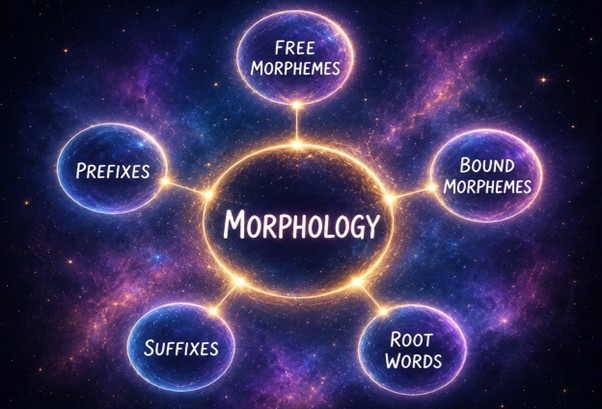
Why morphology matters for literacy and learning.
Morphology is the study of the meaningful parts of words and how those parts work together to create meaning. Rather than viewing words as single units, morphology helps us see that many words are built from smaller pieces that each contribute something to the word’s overall meaning.
These meaningful word parts are called morphemes.
For example, the word unhelpful contains three morphemes: un- (not), help (to assist), and -ful (full of). When these parts of words are combined, they create the meaning “not helpful.” By understanding these smaller parts, students can more easily work out the meaning of unfamiliar words.
For teachers, speech pathologists and parents, morphology offers a powerful way to help children understand how words work. It links directly to oral language because children first learn word meanings, word parts and word relationships through listening and speaking.
Knowledge of morphemes supports reading, spelling, vocabulary, comprehension and writing. When we teach morphology, we are not simply teaching “word parts.” We are helping children see how English words are built in meaningful ways.
A child who understands that help, helpful, helping, helped and unhelpful are connected has a stronger foundation for both oral and written language.
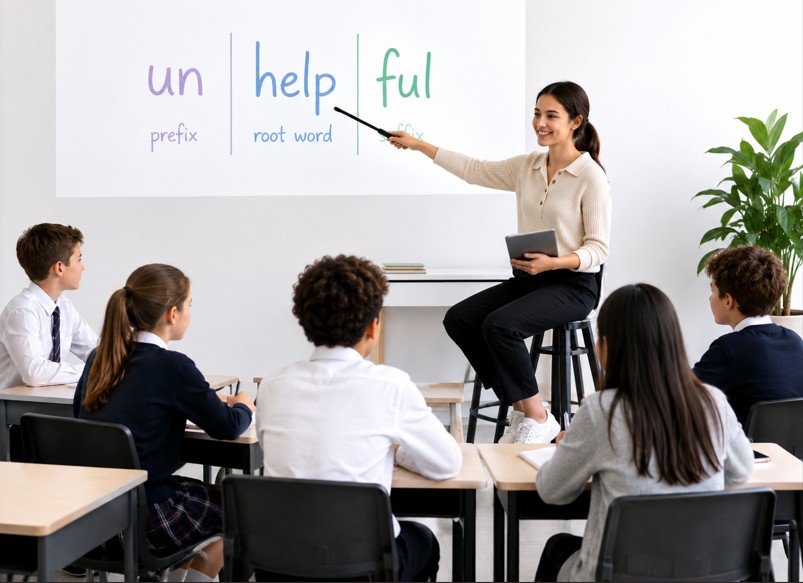
Why Morphology Matters for Literacy and Learning - Important for Reading and Spelling
Why Morphology Matters for Literacy and Learning
When reading, morphology can help us to recognise longer words more efficiently.
So, instead of trying to decode every letter or grapheme in each and every word, we unconsciously or consciously (if it's an unfamiliar word) look for familiar words parts: prefixes, suffixes, base words and word roots.
For example, a student confronted with reading the word unbelievable for the first time in connected text, can break this multi-syllabic word into the prefix un-, the root word believe and the suffix -able.
This skill reduces the load on the student's working memory and enables access to the meaning of the word quickly and efficiently.
When students are spelling, morphological knowledge can help students make more informed choices when attempting to spell an unfamiliar word..
A student who knows that the word jumped is made from the root word jump and the suffix -ed is more likely to spell the word correctly, even if the ending sounds like the phoneme /t/.
Similarly, the student who understands that the word happiness comes from the word happy and the suffix -ness can begin to understand why the spelling changes.
Morphology also supports vocabulary growth. Many academic words are morphologically complex being made with 4, 5 or 6 syllables..
More uncommon words such as prediction, transportation, disagreement, careless and reusable become easier to understand and to spell when students can identify their morphological units.
Why Morphology Matters for Literacy and Learning - Morphemes are the Smallest Units of Meaning
A morpheme is the smallest unit of meaning in a word. Some morphemes can stand alone, known as free morphemes. Words such as dog, play, kind, look and jump are free morphemes because they carry meaning by themselves.
Bound morphemes are different to free morphemes in that they cannot stand alone. They must bind to words.
Prefixes and suffixes are common examples of bound morphemes. The -s in dogs, the -ed in jumped, the un- in unfair and the -ful in hopeful are all bound morphemes. They add meaning to words, but they need to attach to another word or word part.
The concept of free and bound morphemes is important for students with oral language difficulties and should be considered a priority for oral language intervention in early years and middles years of primary school.
Children with oral language difficulties or disorders may use short phrases and simple vocabulary partly because they may not have yet developed a strong awareness of how words can change and expand with addition or deletion of prefixes and suffixes. These skills often need to be explicity taught..
The explicit teaching of how morphemes can actually change words and provide meaning to words is importnt to teach explicitly.
Students with oral language difficulties need a reliable way of recognising and building longer, more complex words with multiple syllables, and understand grammar. This is to ensure that they are better able to express their thoughts and opinions with more precision and clarity both oral and written.

Why Morphology Matters for Literacy and Learning - Developing Morphological Awareness
Morphological awareness is the ability to think about and use morphemes in a structured and intuitive way
This type of awareness can devlop gradually across time but often needs to be explicitly taught by teachers who also have good morphological knowledge.
Scholl based speech pathologists have an important role to play here and have the opportunity to build morphological awareness through short, explicit and engaging activities for students of all ages.
But the explicit teaching of morphological awarenees is perhaps best and especially helpful for older students. In secondary schooling, students who may not struggles with simple words to decode in the early years of schooling often struggle with longer academic vocabulary which feature multisyllabic words and all their attendent prefixes and suffixes..
Instead of students viewing longer, more complex words mostly as mysterious and difficult to both decode and comprehend, we can teach students to approach complex words in a deliberate and strategic way.
This can look like identifying the base word of an unknown and complex word, then finding the prefix, finding the suffix, and successfully decoding it and then ultimetely spelling such a word successfully.
Why Morphology Matter for Literacy and Learning - Final Thoughts
An important principle that we should give thought to is that morphology need to connect with meaning. We teach students word parts to help them understand that words are not simply random strings of letters but that there is an inherent structure and meaning.
When students better understand the morphological structure of words, they gain a deeper understanding of how words are built.
This awareness fosters better readers, more accurate spellers, stronger writers and the promise of more flexible thinkers.
Morphology can provide a roadmap for students to chart a new and deeper appreciation for the intricacies and the beauty of the Englsih language.
Return from Why Morphology Matter for Literacy and Learning to What is Oral Language
References
Moats, L. 2020, Speech to Print: Language Essentials for Teachers, Brookes Publishing
All images made in chatGPT following an iterative process
Updated 06/2026
