Free Sound to Print Reading Screeners

Free Sound to Print Reading Screeners
Learning to read and write begins with language. Before children become successful readers and writers, they must first develop a range of foundational literacy skills that allow them to connect spoken language - speech sounds - to print.
Two of the most important building blocks in early literacy are phonological awareness and alphabetic code knowledge.
The Phonological Awareness Screener (Foundation/Kindergarten) and the Spelling Screener (Years 2–3) were developed as practical, evidence-informed screening tools that have been designed to help teachers and speech pathologists identify children who may be at risk of future literacy difficulties.
Rather than replacing standardized assessments, these informal screeners provide a quick snapshot of a student's literacy foundations and help determine whether further monitoring, intervention, or formal assessment may be required.
Free Sound to Print Reading Screeners - Why Early Screening Matters
Many children in the first few months of school who later experience reading and spelling difficulties, show warning signs well before they begin to struggle academically.
These signs can be subtle and can easily be overlooked.
Early screening allows educators to ask an important question:
"Is this child developing the foundational skills expected for their age?"
By being able to ask this question early in the piece provides school communities with the opportunity to target teaching at the right level with the right students.
Free Sound to Print Reading Screeners - Phonological Awareness
Reading begins long before children recognise printed words. It begins with hearing and manipulating the sounds within spoken language.
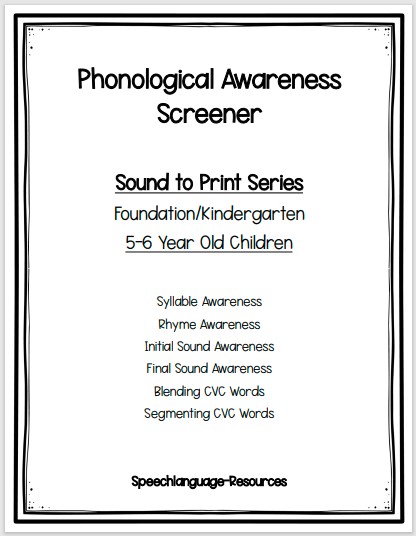
The Phonological Awareness Screener assesses six critical early literacy skills:
- syllable awareness
- rhyme awareness
- initial sound awareness
- final sound awareness
- sound blending
- sound segmentation
Together, these skills form the foundation upon which decoding and spelling are built. The screener includes clear administration scripts, practice items and scoring sheets, making it practical for classroom teachers, education support staff and speech pathologists to administer.
Importantly, the screener does more than produce a total score. It identifies which specific phonological awareness skills require further teaching, allowing intervention to be targeted.

By Years 2 and 3, many literacy difficulties become less obvious. Some students can read reasonably well but struggle to spell increasingly complex words accurately.
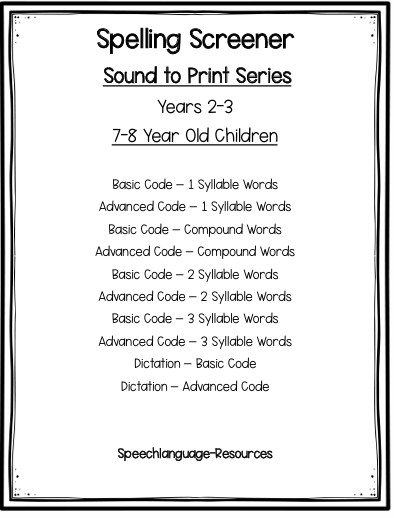
The Spelling Screener examines children's developing knowledge of the alphabetic code across a carefully graded sequence, including:
basic code one-syllable words
advanced code one-syllable words
compound words
multisyllabic words
sentence dictation
One of the strengths of the screener is its distinction between basic alphabetic code knowledge and advanced alphabetic code knowledge. While many students master simple, consistent spelling patterns, difficulties often emerge once sounds can be represented by multiple spelling choices. By identifying exactly where these breakdowns occur, educators are better able to plan targeted spelling instruction.
Why These Screeners Should be Useful for Speech-Language Pathologists
Speech pathologists are increasingly involved in literacy because reading and spelling develop directly from oral language. These screeners complement traditional assessments of speech, vocabulary and language by providing valuable information about the literacy skills that underpin reading success.
For children with speech sound disorders, Developmental Language Disorder (DLD), dyslexia, autism or other learning difficulties, the results can help determine whether intervention should focus on phonological awareness, alphabetic code knowledge, or both.
The screeners can also assist speech pathologists in establishing therapy priorities and measuring progress over time.
Why Teachers Should Find Them Valuable
Teachers often recognise that a student is struggling but are unsure precisely why. These screeners help move beyond broad observations such as "poor reading" or "weak spelling" by identifying the specific skills requiring additional instruction.
Because each screener can be administered in approximately 10–15 minutes using simple scripts and straightforward scoring procedures, they are practical for use within busy classrooms.
The information gathered can then be used to:
- identify students who may require additional support
- guide small-group intervention
- monitor student progress
- inform referrals for more comprehensive assessment.
The greatest value of these screeners lies not in the overall score but in the patterns they reveal.
For example, a child who performs well on syllable awareness but poorly on sound segmentation is likely to require different instruction from a child who struggles across all areas of phonological awareness. Similarly, a student who spells basic code words accurately but struggles with advanced code spellings requires a different teaching focus from one who has weaknesses across the entire alphabetic code.
These patterns allow intervention to be far more precise and effective.
Spelling Screener
Click on the page below to download the screener.
Phonological Awareness Screener
Click on the page below to download the screener.
Free Sound to Print Reading Screeners - A Practical Starting Point
No informal screener can diagnose dyslexia, Developmental Language Disorder or other literacy disorders. However, effective screening helps educators identify students who may be at risk and provides valuable information about where instruction should begin.
The Phonological Awareness Screener and Spelling Screener were designed to do exactly that. They offer teachers and speech pathologists a quick, practical and informative way to examine children's developing literacy skills and identify those who may benefit from additional support.
Used alongside high-quality classroom instruction and evidence-based intervention, these screeners allow schools to identify literacy difficulties earlier, target teaching more accurately, and give children the strongest possible foundation for future reading and writing success.
Illustrations on this webpage have been created using OpenAI's ChatGPT image-generation tools, with creative direction, editing and selection by Speech Language Resources
Updated 06/2026
