Free Active Listening Activities
Free Active Listening Activities
This is an older page which has undergone a recent rework, June 2026. The free programs that you can download from this page remain unaltered. They're oldies but goodies.
Listening is one of the most important skills children use throughout the school day. Every lesson requires students to listen to instructions, hold information in working memory, understand the meaning of what they have heard, and then respond appropriately.
For many children, particularly those with developmental language disorder (DLD), attention difficulties or working memory weaknesses, this process is far more demanding than it appears.
The free Active Listening Activities have been designed to explicitly teach these skills in a structured and engaging way. Rather than assessing what students can already do, the activities provide repeated opportunities for students to practise listening carefully to increasingly complex oral instructions while receiving as much support as they need to succeed.
These are teaching activities, not assessments
It is important to remember that these programs are designed to teach oral language listening skills, not to assess them.
Students should never feel pressured to remember every instruction perfectly on the first attempt. The goal is to help them become more successful listeners through guided practice, repetition and appropriate scaffolding.
If a student experiences difficulty, simply repeat the instruction using a slower, clearer voice. If necessary, break the instruction into smaller parts, highlighting one step at a time before combining the complete sequence again.
For example, rather than presenting a long three-step instruction all at once, you might first ask the student to identify the first shape, then add the second instruction, before finally completing the full sequence.
Providing this level of support allows students to experience success while gradually developing the listening and processing skills required for more complex classroom tasks.
Providing appropriate scaffolding
Many students require additional support before they can successfully process longer oral instructions.
Some helpful strategies include:
- slowing your rate of speech
- repeating instructions as often as necessary
- breaking longer instructions into smaller components
- emphasising key words through your voice
- allowing adequate thinking time before expecting a response
- pointing to the correct answer after an unsuccessful attempt
- encouraging students to explain how they arrived at their answer.
The advanced activities intentionally contain some very challenging listening tasks. It is perfectly acceptable to simplify these activities, provide prompts or complete them collaboratively with the student until they become more confident.
The emphasis should always remain on learning rather than testing.
Vocabulary knowledge matters
Successful listening involves much more than simply hearing words.
Students must also understand the language contained within the instruction. Many children who experience language difficulties find positional and sequencing concepts particularly challenging.
Some students may struggle with place concept and temporal words such as:
- before
- after
- beside
- next to
- between
- beneath
- above
- behind
- in front of
- first
- second
- last.
If students do not yet understand these concepts, the listening activities may initially appear much more difficult than they really are.
For these students, spend time explicitly teaching the vocabulary before attempting the more complex listening sequences. Once the language itself becomes familiar, students are often able to make solid progress.
Using the activities
Preparation is very straightforward.
Print and laminate the coloured shapes board provided in the appendix. This board will be used throughout both programs.
For each activity:
- Read the instruction aloud using a clear, natural voice.
- Allow students sufficient time to process the information.
- Students point to the required shapes in the correct order.
- Record the student's response on the accompanying score sheet.
- Provide feedback and repeat or scaffold the instruction whenever necessary.
Avoid rushing students. Many children require several seconds to process verbal information before they are ready to respond.
Giving students adequate thinking time is often just as important as repeating the instruction itself.

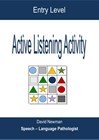
Free Active Listening Activities - Entry Level Program
The Entry Level Program introduces students to simple one-, two- and three-step listening instructions.
The activities use familiar shapes including circles, squares, triangles and stars. Because the shapes are highly recognisable, students can focus their attention on listening rather than first identifying unfamiliar symbols.
The Entry Level Program is suitable for many students from approximately five years of age onwards, although older students with language or learning difficulties may also benefit from beginning at this level before progressing to the advanced activities.
The gradual increase in complexity allows students to experience repeated success while steadily strengthening their listening, working memory and oral language skills.
Click on the Image to Download the PDF file
Free Active Listening Activities - Advanced Level Program
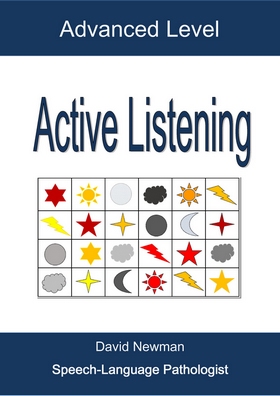
The Advanced Level Program has been designed for students who are ready for significantly more demanding listening tasks.
Instructions become considerably longer and require students to process multiple pieces of information simultaneously.
The shapes also become more sophisticated. Rather than using only common geometric shapes, students work with symbols representing celestial objects and weather phenomena.
This requires students to carefully discriminate between visually similar shapes while continuing to follow increasingly complex verbal instructions.
For example, students may be asked to identify a four-sided star rather than a five-sided star or distinguish between several visually similar symbols presented on the same board.
These additional demands more closely reflect the types of complex listening tasks students encounter in classroom learning.
Because of this increased complexity, repetition, prompting and teacher support are entirely appropriate throughout the program.A practical classroom and home resource.
Click on the Image to Download the PDF file
Free Active Listening Activities - A Practical Classroom and Home Resource
Illustrations on this webpage have been created using OpenAI's ChatGPT image-generation tools, with creative direction, editing and selection by Speech Language Resources
Both Active Listening Programs require very little preparation. Once the shapes board has been printed and laminated, the activities are ready to use immediately.
The programs work equally well with individual students, small intervention groups or within classroom support sessions.
They also make excellent homework activities. Parents can easily read the instructions aloud while children point to the shapes, creating valuable opportunities to practise listening skills in a relaxed home environment.
Many children enjoy the activities because they feel more like a listening game than a traditional language exercise. As students gain confidence, the activities become increasingly engaging while quietly strengthening the language processing skills that underpin successful learning across every area of the curriculum.
Download the Entry Level Program to begin with simple one-, two- and three-step instructions using familiar shapes.
When students are ready for a greater challenge, progress to the Advanced Level Program, where increasingly complex instructions and more sophisticated symbols provide a stimulating next step in developing active listening skills.
Return from Active Listening Activities to SpeechLanguage-Resources Home Page
Updated 06/2026
